
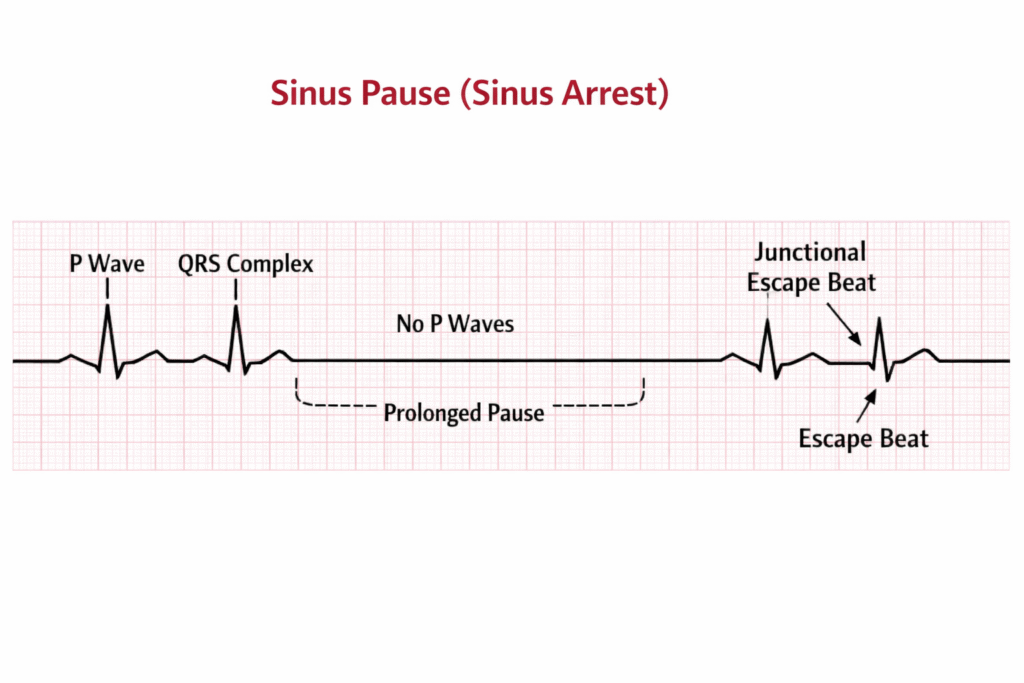
Sinus Pauses (Sinus Arrest)
1. Definition
A sinus pause is a temporary failure of the sinoatrial (SA) node to generate an impulse, resulting in absence of atrial depolarization (no P wave) for a variable duration.
If the pause is prolonged and not a multiple of the basic sinus cycle length, it is termed sinus arrest.
2. Normal SA Node Physiology
The SA node:
- Located in the high right atrium
- Primary pacemaker (rate 60–100 bpm)
- Generates impulses via spontaneous phase 4 depolarization
- Blood supply:
- RCA (~60%)
- LCX (~40%)
Pacemaker hierarchy:
- SA node (60–100 bpm)
- AV node (40–60 bpm)
- Ventricular escape (20–40 bpm)
If SA node fails → subsidiary pacemaker may take over.
3. ECG Definition & Diagnostic Criteria
A. Sinus Pause
- Sudden absence of P wave
- Pause duration < 3 seconds (classically)
- After pause, sinus rhythm resumes
B. Sinus Arrest
- Prolonged absence of P waves
- Pause NOT a multiple of preceding P–P interval
- May be followed by:
- Sinus beat
- Junctional escape beat
- Ventricular escape beat
C. Sinoatrial Exit Block
Feature | Sinus Pause/Arrest | SA Exit Block |
SA node fires? | No | Yes |
Impulse exits atrium? | No impulse formed | Impulse blocked |
Pause duration | Not multiple of P–P | Multiple of P–P interval |
If pause equals 2× basic P–P interval → think SA exit block.
4. ECG Appearance
Typical findings:
- Missing P-QRS-T complex
- Flat baseline during pause
- Escape rhythm may appear if pause prolonged
5. Etiology
A. Intrinsic SA Node Disease
Most common cause in elderly
- Sick sinus syndrome
- Fibrosis of SA node
- Ischemia (RCA infarct)
- Infiltrative disease
- Post-cardiac surgery
B. Extrinsic (Reversible) Causes
1. Increased Vagal Tone
- Athletes
- Sleep
- Carotid sinus hypersensitivity
- Vasovagal episodes
2. Drugs
- Beta blockers
- Non-DHP CCB (verapamil, diltiazem)
- Digoxin
- Amiodarone
- Ivabradine
- Adenosine
3. Metabolic Causes
- Hyperkalemia
- Hypothyroidism
- Hypoxia
- Increased ICP
4. Myocardial Infarction
Especially inferior wall MI (RCA involvement)
6. Clinical Presentation
Depends on pause duration:
Pause Duration | Clinical Effect |
< 2 sec | Usually asymptomatic |
2–3 sec | Dizziness |
> 3 sec | Syncope (Stokes-Adams attack) |
Prolonged | Cardiac arrest (if no escape rhythm) |
Symptoms:
- Lightheadedness
- Fatigue
- Syncope
- Palpitations
- Exercise intolerance
7. Indications for Permanent Pacemaker
Permanent pacing is indicated in:
✔ Symptomatic sinus pauses
✔ Sinus pause > 3 seconds with symptoms
✔ Asymptomatic pause > 6 seconds (selected cases)
✔ Tachy-brady syndrome
✔ Sinus node dysfunction with syncope