
Hypertensive Crisis
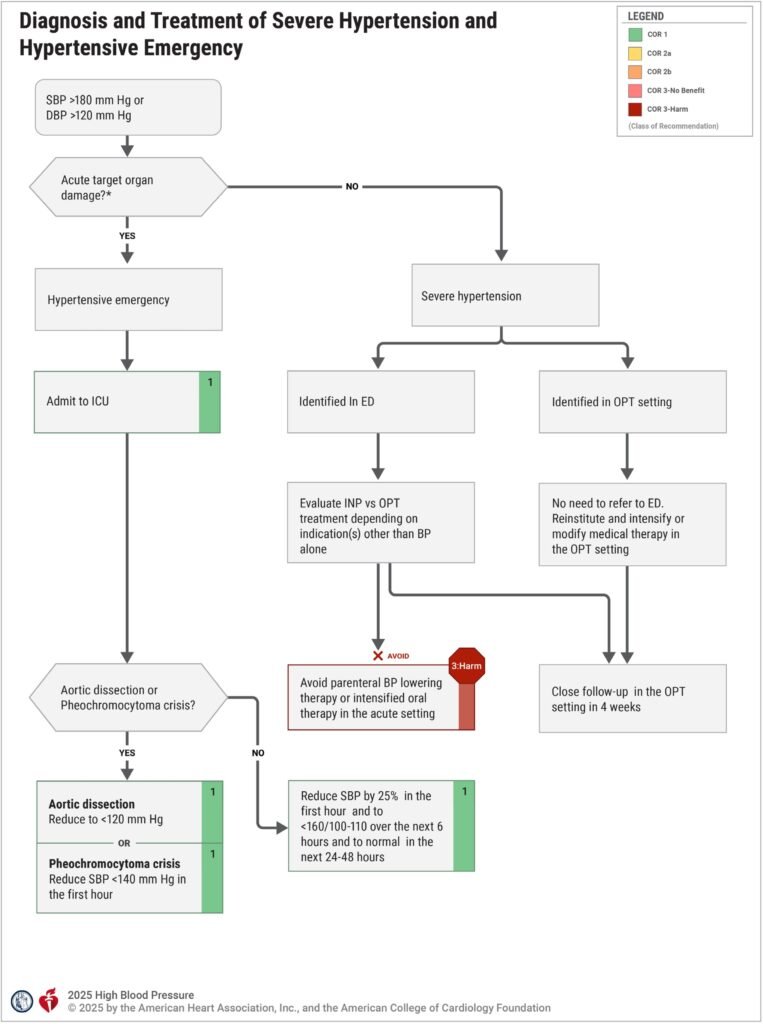
Hypertensive crisis is a spectrum of severe blood pressure elevation associated with actual or potential acute target-organ damage. It is broadly classified into:
- Hypertensive Emergency
- Hypertensive Urgency (The 2024 AHA Scientific Statement and 2025 AHA/ACC Hypertension Guideline recommend abandoning the term “hypertensive urgency.” Instead, patients are classified as:severe asymptomatic hypertension)
Table of Contents
ToggleHypertensive Emergency
- Severe elevation of BP associated with acute target-organ injury(patient already diagnosed with CKD present with High B.P is not hypertensive emergency it is urgency)
- Typically:SBP ≥180 mmHg and/or DBP ≥120 mmHg OR MAP of at least >135 mm (this value is not universal as it depends on baseline B.P)
- therefore:
- Absolute BP number is less important than relative change in blood pressure from baseline
- Emergencies can occur at lower BP, especially in:
- Pregnancy
- Acute glomerulonephritis
- Pheochromocytoma
- Children
Clinical Features
Symptoms depend on organ involved.
Organ | Manifestation |
Brain | Hypertensive encephalopathy, stroke,PRES |
Heart | ACS, LV failure, pulmonary edema |
Aorta | Aortic dissection |
Kidney | AKI |
Retina | Papilledema, retinal hemorrhage |
Pregnancy | Eclampsia |
Hypertensive Urgency
- Severe BP elevation WITHOUT acute target-organ damage.
- Usually:SBP ≥180 mmHg or DBP ≥120 mmHg
- Patients may have:Headache/Anxiety/Mild dyspnea/Epistaxis
Epidemiology
- ~1–2% of hypertensive patients develop hypertensive crisis.
- Hypertensive emergencies account for:~25% of hypertensive crises
- Most common in:
- Chronic uncontrolled hypertension
- Nonadherence to medications
- CKD
- Elderly
- Substance abuse (cocaine, amphetamines)
Causes
Cause / Category | Examples / Notes |
Chronic hypertension | Most common overall cause |
Medication noncompliance | Poor adherence; sudden withdrawal of clonidine or β-blockers,Alcohol or benzodiazepine |
Reversible causes | Volume overload.Hypercapnia, or nonadherence with CPAP or BiPAP therapy for sleep disordered.,Pain,Anxiety, agitation. Urinary obstruction. |
Renal disease | CKD, glomerulonephritis (GN), renal artery stenosis (RAS),Scleroderma renal crisis. |
Endocrine disorders | Pheochromocytoma, hyperaldosteronism, Cushing syndrome, thyrotoxicosis |
Drugs / Substances | Cocaine, amphetamines, MAO inhibitors, NSAIDs, erythropoietin, calcineurin inhibitors,Steroids |
Pregnancy | Severe preeclampsia, eclampsia |
Neurologic disorders | Stroke, head injury,Autonomic dysreflexia following spinal cord injury |
Diagnostic Evaluation
History
- Duration of hypertension/Medication adherence
- Drug use/Pregnancy
- Baseline B.P
- Neurologic symptoms/Chest pain/Dyspnea/visual disturbance, headache
Physical Examination
- BP—Both arms—Repeated measurements
- Neurologic exam
- Fundoscopy
- Cardiovascular exam
- Volume status
Investigations
Test | Purpose |
CBC | Hemolysis, anemia |
RFT | AKI |
Electrolytes | End-organ dysfunction |
Urinalysis | Proteinuria, hematuria |
ECG | Ischemia/LVH |
Troponin | ACS |
Chest X-ray | Pulmonary edema |
Condition | Imaging |
Stroke | CT/MRI brain |
Aortic dissection | CT angiography |
Pulmonary edema | Echo |
PRES | MRI brain |
Management
- First treat the reversible causes because if you give antihypertensive first and later reversible cause resolves it will cause overshoot hypotension
- Not every hypertensive emergency requires an arterial line.
- Most ICU patients receiving continuous IV antihypertensive infusions benefit from one.
- Essential in aortic dissection and strongly recommended in patients needing precise, beat-to-beat BP control (e.g., ICH, severe hypertensive encephalopathy, rapidly titrated vasodilator therapy).
- If the patient is stable and BP can be safely managed with intermittent non-invasive measurements, an arterial line is not routinely mandatory.
Lower BP in a controlled manner.Excessively rapid lowering can cause:
- Stroke
- Myocardial ischemia
- Renal ischemia
because chronic hypertensive patients have shifted autoregulation curves.
BP Reduction Targets
Most Hypertensive Emergencies
- Goal:Reduce MAP by 20–25% within first hour(AHA-2025)
- Then:BP to ~160/100–110 mmHg over next 6 hours
- Then gradual normalization over 24–48 hours.
Exceptions
Condition | BP Goal |
Aortic dissection | SBP <120 within 20 min |
Eclampsia | SBP <160, DBP <105 |
Ischemic stroke thrombolysis candidate | <185/110 |
ICH | SBP ~140 |
PRES | Controlled rapid reduction |
Pheochromocytoma CRISIS | SBP <140 within first hour |
Preferred Drugs According to Clinical Scenario
Clinical Scenario | Preferred Drugs |
Aortic dissection | Esmolol + Nicardipine/Nitroprusside |
Acute pulmonary edema | Nitroglycerin, Clevidipine, Nicardipine |
Hypertensive encephalopathy | Nicardipine, Labetalol |
Intracerebral hemorrhage | Nicardipine, Clevidipine |
Ischemic stroke | Nicardipine, Labetalol |
Preeclampsia/eclampsia | Labetalol, Hydralazine, Nicardipine + Magnesium sulfate |
Cocaine/amphetamine crisis | Benzodiazepines + Phentolamine/Nicardipine |
Acute coronary syndrome | Nitroglycerin + Beta blocker |
Acute renal failure | Fenoldopam, Nicardipine |
IV Drugs Used in Hypertensive Emergency
Drug | Dose | Contraindications / Major Avoidance Situations |
Nicardipine-(DHP-CCB)(2nd-Best infusion agent) | IV infusion: Start 5 mg/h, increase by 2.5 mg/h every 5–15 min until target BP achieved. Maximum: 15 mg/h.When Bp reaches target, reduce the infusion to 3-5 mg/hr to prevent accumulation. | C.I-Cirrhosis,Strong CYP 3A4 inhibitors,Acute coronary ischemia (may cause reflex tachycardia). S.E-Reflex tachycardia.
|
Clevidipine-(DHP-CCB)(Best infusion agent) | IV infusion: Start 1–2 mg/h; double dose every 90 sec initially, then titrate every 5–10 min. Typical: 4–6 mg/h. Max ~21–32 mg/h depending on protocol. | C.I- hypertriglyceridemia and pancreatitis.Allergy to soybeans or eggs. S.E-Reflex tachycardia.
|
Labetalol | Bolus: 20 mg IV over 2 min → then 40-60–80 mg-80-80 every 10 min as needed (max cumulative ~300 mg).If a total dose of 300mg doesn’t work, switch to another agent. Infusion: 0.5–2 mg/min.(infusion dose accumulates so try to avoid) | Asthma, COPD with bronchospasm, bradycardia, second/third-degree AV block, cardiogenic shock, acute decompensated heart failure, severe peripheral vascular disease, cocaine intoxication with unopposed α activity concern (relative). |
Esmolol | Loading: 500 mcg/kg over 1 min → infusion 50 mcg/kg/min; titrate up to 300 mcg/kg/min. | Asthma, COPD with bronchospasm, bradycardia, second/third-degree AV block, cardiogenic shock, acute decompensated heart failure, |
Metoprolol | IV: 2.5–5 mg every 5 min up to 15 mg total(equivalent to ~37.5 mg PO metoprolol tartrate).
| |
Nitroglycerin | IV infusion: Start 5 mcg/min; increase by 5 mcg/min every 3–5 min. Higher doses (100–200 mcg/min or more) may be needed in pulmonary edema. tachyphylaxis often develops within 24-48 hours. For SCAPE- Loading 400-800 mcg/min for 2.5 minutes. | S.E—Hypotension,Reflex tachycardia,Headache (most patients),Methemoglobinemia (rare; may relate to G6PD deficiency or dose). C.I—right ventricular infarction, severe aortic stenosis, hypertrophic obstructive cardiomyopathy, recent PDE-5 inhibitor use (sildenafil within 24 h; tadalafil within 48 h), raised ICP . |
Nitroprusside | IV infusion: 0.3–0.5 mcg/kg/min initially; titrate to max 10 mcg/kg/min (avoid prolonged >>48 hours high-dose use).Due to potency, intra-arterial BP monitoring is recommended to prevent “overshoot. | C.I—Renal failure (risk of thiocyanate toxicity), hepatic failure (cyanide toxicity), pregnancy, raised intracranial pressure, vitamin B12 deficiency, optic atrophy, Leber hereditary optic neuropathy, Recent use of phosphodiesterase inhibitors (e.g., sildenafil) tachyphylaxis often develops within 24-48 hours. |
Hydralazine(Arteriolar vasodilator) | IV/IM: 5–20 mg every 4–6 h as needed.maximum cumulative IV dose 40 mg.1:2-1:4 IV to PO conversion | Coronary artery disease due to reflex tachycardia , aortic dissection, tachyarrhythmias, hypertrophic cardiomyopathy, lupus (long-term use concern), severe tachycardia. |
Fenoldopam | IV infusion: Start 0.1 mcg/kg/min; titrate every 15 min. Typical 0.1–1.6 mcg/kg/min. | Glaucoma, increased intraocular pressure, sulfite allergy, tachycardia. |
Phentolamine | IV bolus: 5–15 mg slow IV; repeat as required. | Coronary artery disease, peptic ulcer disease, recent MI (relative). |
Enalaprilat | IV: 0.625–1.25 mg every 6 h; may increase to 5 mg every 6 h.only IV form of an ACEi/ARB. | Pregnancy, bilateral renal artery stenosis, hyperkalemia, acute kidney injury, angioedema history with ACE inhibitors. |
Urapidil (not universally available) | IV bolus: 10–50 mg slowly, then infusion 5–40 mg/h. | Aortic isthmus stenosis, AV shunts, severe bradycardia, cardiogenic shock. |
Propranolol | IV: 1 mg over 1 min; repeat every 2 min up to 5 mg.?? | Other uses
|
When to Transition to Oral Medication?
Patient should meet ALL of the following
Criteria | Requirement |
Target BP achieved | Desired BP reached for that specific emergency (not necessarily normal BP) |
IV infusion stable | Minimal or no dose adjustments for 6–24 hours (depends on condition) |
Target-organ injury stabilized | No ongoing neurological deterioration, myocardial ischemia, pulmonary edema, etc. |
Hemodynamically stable | No hypotension or major BP fluctuations |
Able to take oral medications | Awake, swallowing safely, functioning GI tract (or enteral tube available) |
No immediate need for rapidly titratable therapy | BP no longer requires minute-to-minute adjustment |
How to Transition
Step 1 – Identify the Cause
Choose medications based on the underlying disease, not just the BP.
Condition | Preferred Oral Drugs |
General hypertension | ACEI/ARB + CCB ± thiazide |
CAD/Post-MI | β-blocker + ACEI/ARB |
Heart failure | ACEI/ARB/ARNI + β-blocker + MRA |
CKD with albuminuria | ACEI/ARB |
Aortic dissection | β-blocker first, then ACEI/ARB or CCB if needed |
Pregnancy | Labetalol, nifedipine ER |
Step 2 – Start Oral Medication Before Stopping the IV Infusion
- Do not stop the infusion first.
- Give the first oral dose while the IV infusion is still running to allow time for the oral medication to take effect.
- Amlodipine very late onset of action – little role for acute BP management.
- Metoprolol drops the heart rate, but is relatively ineffective for controlling blood pressure.
Step 3 – Gradually Wean the IV Infusion
Avoid abrupt discontinuation.
Example:
- Reduce infusion by 25–50%
- Observe BP for 30–60 minutes
- If BP remains stable, reduce further
- Stop infusion once oral therapy is effective
Hypertensive Urgency Management
- NO Need Of aggressive rapid B.P lowering therefore Urgency is misnomer.BP reduction Gradual over days to weeks
- There is NO need for referral to the emergency department.(AHA-2017)
- There is NO need for hospital admission.(AHA-2017)
Management:
- Identify reversible causes(Pain, anxiety, urinary retention, hypoxia, hypercapnia, alcohol withdrawal, medication noncompliance, sympathomimetics, NSAIDs, steroids, excess IV fluids, etc. Treat these first.)
- Routine extensive work-up is not required solely because BP is elevated.
- Reinstitute missed medications
- Intensify Oral antihypertensives
- Observe briefly if needed to ensure stability, not necessarily until BP normalizes.
- Follow-up within days
- Long-term outpatient target—Usually <130/80 mmHg for most adults, individualized based on age, frailty, CKD, diabetes, ASCVD risk, etc.
Drugs to Avoid for “Hypertensive Urgency” (Asymptomatic Markedly Elevated BP)
Drug | Reason |
Sublingual or immediate-release nifedipine | Can cause abrupt hypotension, myocardial ischemia, stroke |
Routine IV labetalol, nicardipine, clevidipine, nitroprusside | Reserved for hypertensive emergency with acute target-organ damage |
Routine use of oral clonidine or hydralazine solely to normalize BP before discharge | May produce unpredictable BP reduction without improving outcomes; focus should be on optimizing chronic therapy and arranging follow-up rather than rapid normalization. |
Oral Drugs in Hypertensive Urgency
Drug (Class) | Dose | Side Effects / Contraindications (CI) |
Amlodipine (DHP-CCB) | 5 mg OD (2.5 mg in elderly/frail) → Increase by 2.5–5 mg every 1–2 weeks → 10 mg/day | SE: Pedal edema, flushing, headache, dizziness, palpitations, gingival hyperplasia.Safe in CKD and diabetes. |
Nifedipine ER (DHP-CCB) | 30 mg OD → Increase every 1–2 weeks → 90–120 mg/day(formulation dependent) | SE: Edema, headache, flushing, reflex tachycardia. CI: Avoid immediate-release/sublingual nifedipine (can cause stroke/MI from abrupt hypotension). |
Lisinopril (ACEI) | 10 mg OD (5 mg if on diuretic/CKD) → Double every 2–4 weeks → 40 mg/day | SE: Dry cough, hyperkalemia, AKI, angioedema. CI: Pregnancy, bilateral renal artery stenosis, previous ACEI angioedema, K⁺ >5.5 mmol/L,AKI. |
Enalapril | 5 mg OD/BD → Increase every 1–2 weeks → 40 mg/day | Same as ACE inhibitors. |
Ramipril | 2.5 mg OD → Increase every 2 weeks → 20 mg/day | Same ACEI adverse effects. |
Losartan (ARB) | 50 mg OD (25 mg if elderly/volume depleted) → Increase after 2–4 weeks → 100 mg/day | SE: Hyperkalemia, AKI, dizziness. CI: Pregnancy, bilateral renal artery stenosis. Lower risk of cough/angioedema than ACEIs. |
Valsartan | 80 mg OD → Increase every 2 weeks → 320 mg/day | Same as ARBs. |
Telmisartan | 40 mg OD → Increase after 2–4 weeks → 80 mg/day | Same as ARBs. |
Olmesartan | 20 mg OD → Increase after 2 weeks → 40 mg/day | SE: Hyperkalemia, rare sprue-like enteropathy. CI: Pregnancy. |
Hydrochlorothiazide (Thiazide) | 12.5–25 mg OD → Increase after 2–4 weeks → 50 mg/day(little benefit >25 mg) | SE: Hypokalemia, hyponatremia, hyperuricemia, hyperglycemia, photosensitivity. CI: Anuria, caution in gout. |
Chlorthalidone (Preferred Thiazide-like) | 12.5 mg OD → Increase after 2–4 weeks → 25 mg/day(occasionally 50 mg) | SE: More hypokalemia than HCTZ, hyponatremia, hyperuricemia. CI: Anuria. Better outcome data than HCTZ. |
Metoprolol Succinate (β1-selective) | 25–50 mg OD → Double every 1–2 weeks → 200 mg/day | SE: Bradycardia, fatigue, depression, sexual dysfunction. CI:Severe bradycardia, AV block, cardiogenic shock. Use mainly if CAD, HF, AF. |
Bisoprolol | 2.5–5 mg OD → Increase every 2 weeks → 20 mg/day | Same β-blocker adverse effects. |
Atenolol | 25–50 mg OD → Increase every 2 weeks → 100 mg/day | Same β-blocker adverse effects. Requires renal dose adjustment. |
Carvedilol (α+β blocker) | 6.25 mg BD → Double every 1–2 weeks → 25 mg BD (50 mg/day) | SE: Orthostatic hypotension, bradycardia. CI: Severe asthma, AV block, cardiogenic shock. Preferred in HFrEF. |
labetalol | 200 mg B.D,maximal dose is 2400 mg/day | in pregnancy, high doses may pose a risk of fetal bradycardia. |
Prazosin | 1-2 mg HS → Increase gradually To B.D/T.D.S →Max dose 20 mg/day(10 mg B.D) | Same as α-blockers; marked first-dose hypotension.Orthostatic hypotension and falls.Drowsiness.Headache, vertigo, nausea. Not a first-line chronic agent but can be used for resistant hypertension. |
Clonidine (Central α2-agonist) | 0.1 mg BD → Increase every few days → 0.6–0.8 mg/day | SE: Sedation, dry mouth, constipation, rebound hypertension if stopped abruptly. CI: Avoid routine use for asymptomatic markedly elevated BP; avoid abrupt withdrawal. |
Methyldopa | 250 mg BD/TDS → Increase every 2 days → 3 g/day | SE: Sedation, hepatitis, Coombs-positive hemolytic anemia. CI:Active liver disease. Preferred in pregnancy. |
Hydralazine (Oral) | Arteriolar vasodilator decreases systemic vascular resistance and generally increases cardiac output. 10–25 mg TDS–QID → Increase every 2–5 days → 300 mg/day(100mg TDS)—Dose adjustment needed in renal failure | SE: Headache, reflex tachycardia, edema, drug-induced lupus. CI: CAD, tachyarrhythmias,Aortic dissection,High-output heart failure,connective tissue diseases (hydralazine may cause medication-induced lupus). Not a first-line chronic agent. |
Spironolactone (MRA) | 25 mg OD → Increase after 4 weeks → 100 mg/day | SE: Hyperkalemia, gynecomastia, menstrual irregularities. CI:K⁺ >5 mmol/L, eGFR <30 mL/min/1.73 m², Addison disease. Preferred add-on for resistant hypertension. |
Eplerenone (MRA) | 25 mg OD → Increase after 4 weeks → 50 mg BD (100 mg/day) | SE: Hyperkalemia; less endocrine effects than spironolactone. CI: Hyperkalemia, severe CKD. |
Renal Dose Adjustment Required
- Lisinopril, Enalapril.Ramipril, Perindopril
- Olmesartan (severe CKD)
- Bisoprolol
- Atenolol,Nebivolol, Methyldopa
- ⚠️ Clonidine
- ⚠️ Hydralazine (severe CKD)
Avoid or Use with Extreme Caution
- ❌ Spironolactone (eGFR <30 or hyperkalemia)
- ❌ Eplerenone (significant CKD)
- ⚠️ Hydrochlorothiazide (ineffective when eGFR <30)
- ⚠️ Indapamide (avoid in severe renal failure)
Remember the pattern:
- ACE inhibitors → Dose adjustment required.
- Most ARBs → No routine dose adjustment, but monitor renal function and potassium.
Stepwise Approach to Oral Antihypertensive Therapy
According to the 2025 ACC/AHA Hypertension Guideline, 2024 AHA Scientific Statement, and standard hypertension management principles, the approach depends on how far the BP is above goal, current medications, and patient characteristics—not simply on the absolute BP at presentation.
Clinical Situation | Recommended Approach | Reason |
Not taking any antihypertensive (new diagnosis or stopped medication) | Start 1 or 2 first-line drugsdepending on BP level | Initiate long-term therapy rather than trying to normalize BP immediately |
Missed medications/non-adherence | Restart previous regimen (if appropriate) | Most patients improve without changing drugs |
On one drug at low/moderate dose | Increase toward target dose oradd another class | Depends on BP elevation and drug tolerance |
On one drug at maximum tolerated dose | Add a second first-line drug | Better BP reduction than further dose escalation if already near max |
On two drugs at reasonable doses | Add third first-line drug | Standard triple therapy |
On ACEI/ARB + CCB + thiazide but uncontrolled | Add spironolactone | Preferred fourth-line agent (PATHWAY-2) |
Why Add Another Drug Instead of Doubling Dose?
Approximate BP reduction:
Intervention | SBP Reduction |
Double dose of same drug | ↓ 2–5 mmHg |
Add second first-line drug | ↓ 8–15 mmHg |
General Titration Timeline
Stage | Time |
Start medication | Day 0 |
Reassess BP | 2–4 weeks |
If not at goal | Increase dose or add another first-line drug |
Reassess | Every 2–4 weeks until goal reached |
Stable | Follow-up every 3–6 months |
Malignant Hypertension
Malignant hypertension is a medical emergency characterized by:
- Severely elevated blood pressure (usually SBP ≥180 mmHg and/or DBP ≥120 mmHg, although there is no absolute BP threshold)
- Grade IV hypertensive retinopathy, specifically:
- Papilledema (hallmark)
- Often accompanied by retinal hemorrhages and/or cotton-wool spots
- Acute target-organ damage, making it a subtype of hypertensive emergency.
Key point: Modern guidelines emphasize acute target-organ damage rather than a specific BP value. Malignant hypertension is not diagnosed by BP alone.
Historical vs Modern Terminology
Older Term | Modern Interpretation |
Accelerated hypertension | Severe hypertension with retinal hemorrhages/exudates (Grade III retinopathy) but no papilledema |
Malignant hypertension | Severe hypertension with papilledema (Grade IV retinopathy) ± other organ damage |
Hypertensive emergency | Umbrella term for severe hypertension with acute target-organ injury; malignant hypertension is one subtype |
Many contemporary guidelines use “hypertensive emergency” preferentially, but malignant hypertension remains a recognized clinical diagnosis when papilledema is present.
Pathophysiology
Severe BP elevation
↓
Failure of autoregulation
↓
Endothelial injury
↓
Fibrinoid necrosis of arterioles
↓
Platelet activation + thrombosis
↓
Microvascular ischemia
↓
Brain • Retina • Kidney • Heart injury
References
- Indian Society of Critical Care Medicine (ISCCM). ISCCM Protocol Book. 3r ed. New Delhi: Jaypee Brothers Medical Publishers; 2025.
- Cline DM, Ma OJ, Cydulka RK, Meckler GD, Thomas SH, Handel DA, et al. The Washington Manual of Emergency Medicine. 4th ed. Philadelphia: Wolters Kluwer; 2023.
- Writing Committee Members, Jones DW, Ferdinand KC, Taler SJ, Johnson HM, Shimbo D, et al. 2025 AHA/ACC/AANP/AAPA/ABC/ACCP/ACPM/AGS/AMA/ASPC/NMA/PCNA/SGIM guideline for the prevention, detection, evaluation, and management of high blood pressure in adults: A report of the American College of Cardiology/American Heart Association Joint Committee on Clinical Practice Guidelines. Hypertension.2025;82(10):e212-e316. doi:10.1161/HYP.0000000000000249.