
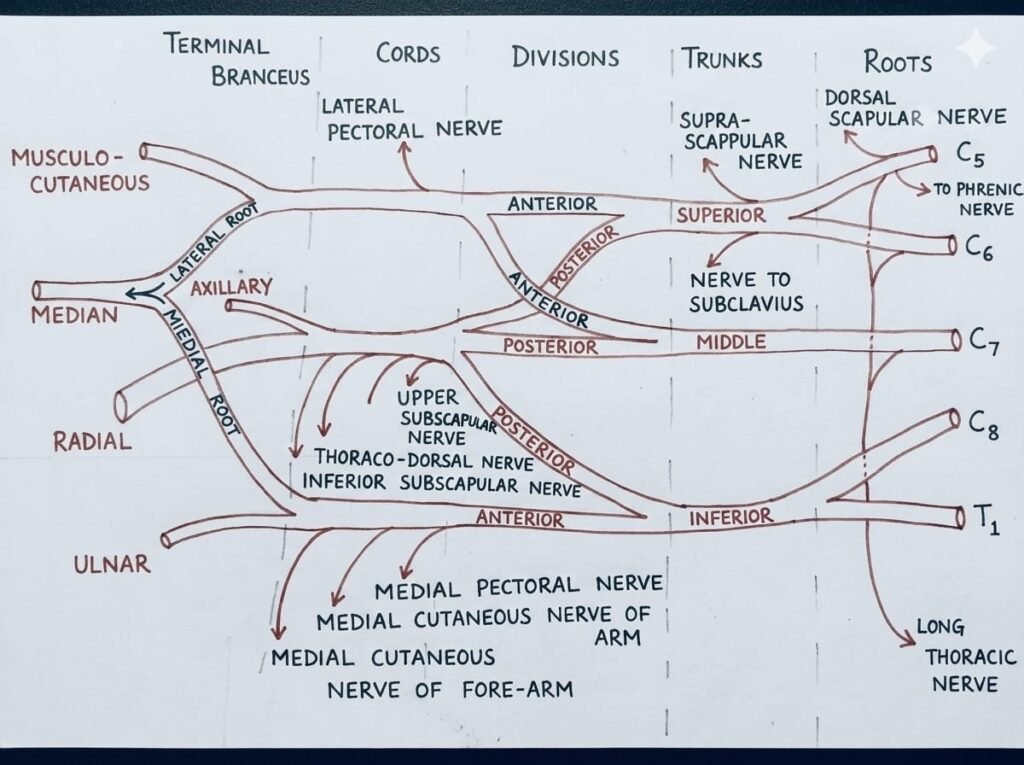
BRACHIAL PLEXUS ANATOMY
Provides sensory and motor innervation to upper limb.
Formation–
- Constitutes anterior primary rami C5 – C8 along with T1.
- Pre-fixed plexus – C4 is involved
- Post- fixed plexus – T2 is involved
- Variations are often associated with cervical rib.
Parts of the brachial plexus:
Roots, Trunks, Divisions, Cords, Branches.
Table of Contents
ToggleRoots:
- Emerge from inter-vertebral foramina.
- Pass behind foramen transversarium of respective vertebra
- Lies between anterior and posterior tubercles of corresponding transverse process.
- Roots lie between scalenus anterior and medius above the second part of subclavian artery.
Trunks:
- Upper trunk : joined roots of C5 -6
- Middle trunk: root of C7
- Lower trunk: root of C8 – T1
Trunks tie between scaliness anterior and medius. Inter scalene block targets trunks.
Divisions:
Each trunk divides into anterior and posterior divisions. Trunks pass between scalenes then downwards and laterally across the base of posterior triangle and then across first rib.
Course –Roots → pass between scalenes → form trunks → between scalenes →reach to the base of posterior triangle of the neck → behind the clavicle at the lateral border of the first rib → form divisions —— move to axilla → form cords → arrange around Axillary artery → at the lateral border of Pectoralis Minor ——- form terminal branches.
Cords:
- Lateral cord: union of anterior divisions of upper and middle trunks.
- Medial cord: continuation of anterior division of lower trunk.
- Posterior cord: union of all three posterior divisions.
Branches:
Directly from roots:
Located supraclavicularly.
- Nerve to Longus Cervicis (C5-6)
- Nerve to scalene muscles (C5-6)
- Nerve to rhomboids (C5)
- Nerve to serratus anterior (C5- 7)
- Continuation of phrenic nerve (C5)
From the trunks:
Located supra-clavicularly
- Nerve to subclavius (C5-6)
- Supra-scapular nerve (C5-6)
From the cords:
Located infra- clavicularly
Lateral cord: Lateral pectoral nerve (C5-7)
(LML) Musculo cutaneous nerve (C5-7) Lateral head of median nerve (C6-7)Medial cord: Medial pectoral nerve (C8-T1)
(M4U) Medial cutaneous nerve of arm (C8-T1) Medial cutaneous nerve of forearm (C8-T1) Medial head of median nerve (C8 -T1) Ulnar nerve (C7-8,T1)
Posterior cord: Upper subscapular nerve (C5 -6)
(ULTRA) Nerve to Latissimus Dorsi / Thoraco -dorsal nerve (C6-8) Lower subscapular nerve (C5 -6)
Axillary nerve (C5-6) Radial nerve (C5-8,T1)
5 terminal branches of brachial plexus supplying upper limb innervation are:
- Musculocutaneous nerve
- Radial nerve
- Median nerve
- Ulnar nerve
- Axillary nerve.
Clinical implications
ERB’s palsy:
Injury to ERB’s point (C5 -6) at the upper trunk of brachial plexus. Cause: Birth injury (often)
Deformity: Arm – hangs by side, addicted and medically rotated.
Forearm → extended and pronated.
Also known as Policeman’s tip hand/ Waiter’s tip hand/ Porter’s tip hand.
KLUMPKE’s palsy:
Involves lower trunk of the tracheal plexus cause Cause: Fall from heigh,Birth injury
Deformity: claw hand due to unopposed action of long flexors and extensors of the fingers.Injury to the nerve of Bell Supplying the muscle serratus anterior. Causes winging of scapula.
Loss of pushing and pulling actions along with overhead abduction.
References
- Harold Ellis and Andrew Lawson ;Anatomy for anaesthesiologists 9th edition ;part 4 ; p 165-189
- BD Chaurasia’s Human anatomy ; Volume 1; Upper limb and thorax; 7th edition; chapter 4:p 56-61
- G J Romanes; Cunninghams manual of practical anatomy; Volume 1; 15th edition; Chapter 2: p 23-33