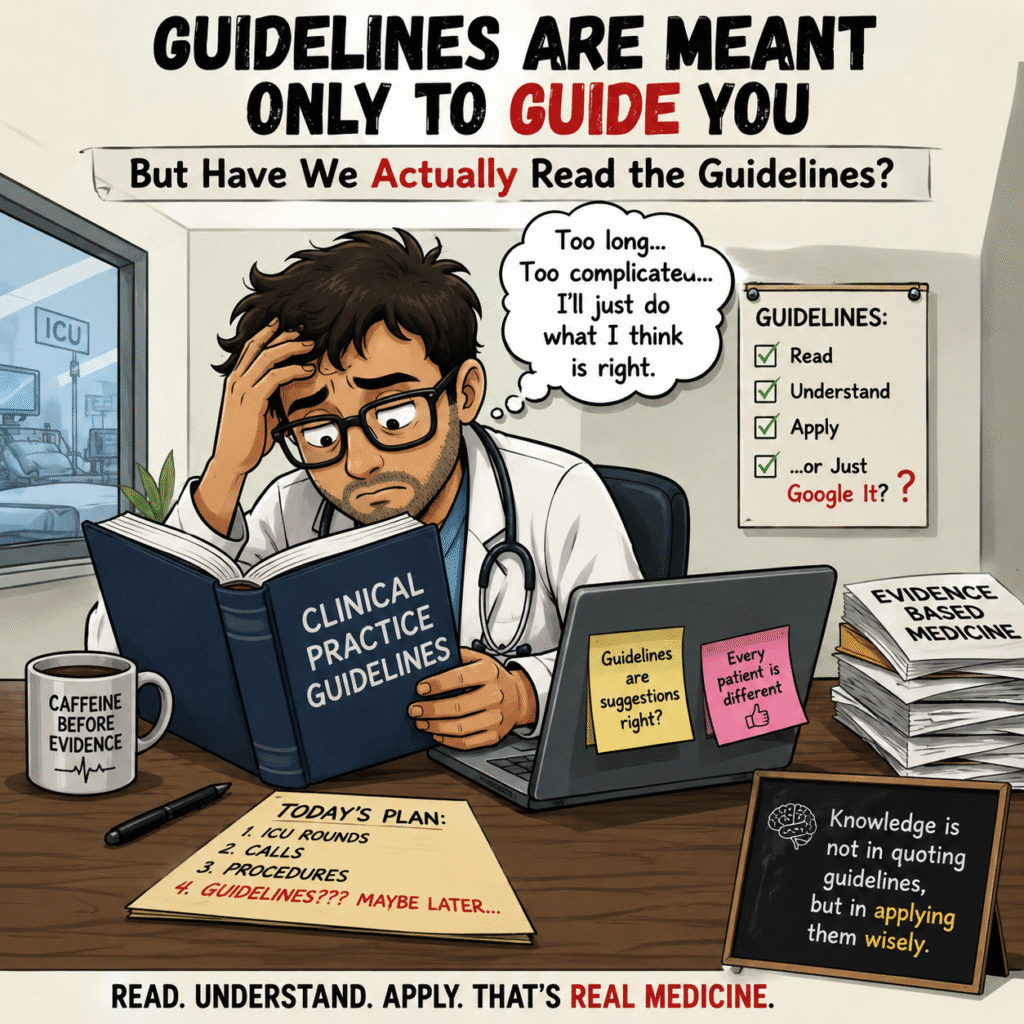
One of the most repeated phrases in medicine is:
“Guidelines are only meant to guide you.”
It sounds wise. It sounds balanced.
But here’s the uncomfortable question:
How many of us have actually read the guideline before saying that?
Guidelines Are More Than Recommendations
Modern clinical guidelines are not someone’s opinion. They are the result of systematic literature reviews, evidence grading, expert consensus, and often thousands of hours of work.
Most major guidelines clearly tell you:
- The quality of evidence behind each recommendation.
- The strength of every recommendation.
- Situations where the recommendation may not apply.
- Areas where evidence remains weak or uncertain.
In other words, good guidelines already acknowledge their own limitations.
The Reality of Residency
Let’s also acknowledge another uncomfortable truth.
Residency is exhausting.
There are endless duties, emergency calls, ward work, paperwork, procedures, exams, presentations, and very little uninterrupted time to sit down and read a 150-page guideline.
So what do most of us do?
We watch our seniors.
We copy what they do.
We assume that if they’ve been doing it for years, it must be correct.
In many situations, we don’t really have another practical option. The system trains us by apprenticeship, and imitation becomes our primary method of learning.
There’s nothing wrong with learning from experienced clinicians.
The problem begins when we mistake inherited practice for evidence.
After Residency, What Changes?
Ironically, after residency we finally gain something we never had before:
Time.
Yet many of us still don’t read the guidelines.
Not because we can’t.
Because we’ve become comfortable with what we already know.
Once a practice has been repeated for years, changing it becomes surprisingly difficult. Human beings naturally defend familiar habits, even when new evidence suggests a better approach.
Reading one guideline or one landmark trial shouldn’t feel like an extraordinary academic achievement worthy of celebration.
For a doctor, staying updated with current evidence is not an optional hobby.
It is part of the profession.
Medicine evolves continuously. If our knowledge doesn’t evolve with it, our patients may receive yesterday’s care instead of today’s best evidence.
“Clinical Judgment” Doesn’t Mean Ignoring Evidence
Some clinicians use the phrase “guidelines are only guidelines” to justify practices that haven’t changed in years.
Clinical judgment is essential—but it should begin after understanding the best available evidence, not instead of it.
Experience without evidence gradually becomes habit.
Evidence without judgment becomes protocol-driven medicine.
Good medicine requires both.
Guidelines Don’t Replace Thinking
No guideline can account for every patient.
- The frail 90-year-old with multiple comorbidities.
- The patient with several contraindications.
- The ICU patient who resembles none of the populations included in clinical trials.
This is where clinical expertise matters.
But exceptions should be based on thoughtful reasoning—not simply on, “This is how I’ve always done it.”
Read Before You Criticize
Before saying a guideline is “impractical” or “not applicable,” ask yourself:
- Have I actually read the full document?
- Do I understand the evidence behind the recommendation?
- Am I disagreeing with the science—or simply resisting a change in practice?
Final Thoughts
Guidelines are not laws.
They do not replace bedside judgment.
They cannot predict every clinical situation.
But they are also not optional reading.
The phrase “guidelines are there only to guide you” should never become an excuse to ignore evidence.
The strongest clinical judgment is built on evidence—not in place of it.
Because in the end, patients deserve doctors whose experience is continuously refined by learning, not simply repeated through habit.