
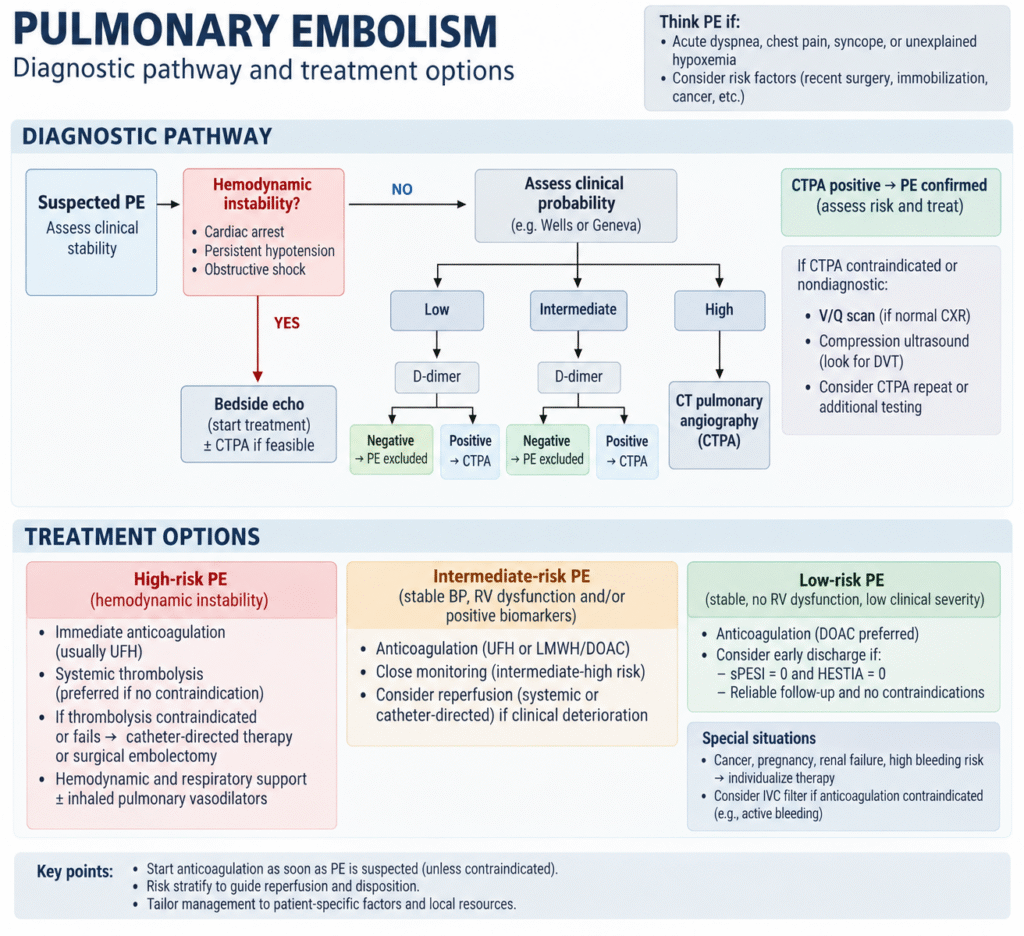
Pulmonary Embolism
Pulmonary embolism is obstruction of the pulmonary arterial circulation, usually by thrombus originating from the deep veins of the lower extremities or pelvis.
Table of Contents
ToggleRisk Factors—Virchow’s Triad
Mechanism | Examples |
Venous stasis | Immobilization, ICU stay |
Hypercoagulability | Cancer, pregnancy |
Endothelial injury | Surgery, trauma,Central venous Catheter |
Major
- Major surgery
- Trauma
- Malignancy
- Prior VTE
- Pregnancy/postpartum
Moderate
- OCP use
- Hormone therapy
- Obesity
- Heart failure
- Stroke
ICU specific(DVT prophylaxis reduces risk in ~50% cases only!!)
- Mechanical ventilation
- Sepsis
- Central venous catheter
- Sedation/paralysis
- ECMO
Provoked vs unprovoked PE
This distinction becomes extremely important when deciding duration of anticoagulation.
Type | Examples |
Major transient risk factor | Major surgery, major trauma, prolonged immobilization |
Minor transient risk factor | Short-term immobility, minor surgery, estrogen exposure |
Persistent risk factor | Active cancer, chronic inflammatory disease, persistent thrombophilia |
Unprovoked | No identifiable provoking factor |
A first PE caused by a major reversible risk factor can generally stop anticoagulation after the initial treatment phase if bleeding/recurrent-risk assessment supports this. In contrast, persistent-risk-factor or unprovoked PE often warrants extended anticoagulation.
Pathophysiology
PE causes three simultaneous processes:
- Mechanical obstruction
- Pulmonary vasoconstriction
- Right ventricular failure
Mechanical Obstruction
Pulmonary vascular obstruction leads to:
- ↑ Pulmonary vascular resistance (PVR)
- ↓ Pulmonary blood flow
- ↑ RV afterload
Pulmonary Vasoconstriction
Mediators released:Thromboxane A2,Serotonin,Histamine,Endothelin
Effects:
- Additional increase in pulmonary vascular resistance
- Worsening RV strain
Right Ventricular Failure
RV normally pumps against low pressure system.
PE causes:↑ RV afterload→ RV dilation→ RV ischemia→ ↓ RV contractility
Consequences:
- Interventricular septal shift
- ↓ LV filling
- ↓ cardiac output
- Hypotension
- Cardiogenic shock
Clinical Presentation
Classic triad (rare)
- Dyspnea
- Chest pain
- Hemoptysis(from lung tissue necrosis)—it is not contraindication of anticoagulation.
Common symptoms
Symptom | Frequency |
Dyspnea | 70–80% |
Pleuritic chest pain | 50% |
Tachypnea | 60% |
Tachycardia | 30–40% |
Syncope | Massive PE |
Anginal chest pain(due to ischemia to the right ventricle).
Low-grade
Examination Look for:
- tachycardia
- tachypnea
- hypoxemia
- hypotension
- raised JVP
- RV heave
- loud P2
- unilateral leg swelling/tenderness
Massive PE symptoms
- Hypotension
- Shock
- Syncope
- Cardiac arrest
Classification of Pulmonary Embolism-AHA 2026
Category | Hemodynamic + RV + Biomarker + Clinical Profile | Management |
A (Low Risk) | Hemodynamically stable; No RV dysfunction; Normal troponin/BNP; Mild or no symptoms, minimal hypoxia | Anticoagulation only (DOAC preferred), early discharge |
B (Intermediate-Low) | Stable BP; Either RV dysfunction OR biomarker elevation (not both); Mild dyspnea, tachycardia | Anticoagulation + close monitoring |
C (Intermediate-High) | Stable BP; Both RV dysfunction + ↑ biomarkers; Tachycardia, hypoxia, early RV failure | ICU monitoring, anticoagulation, rescue thrombolysis if deterioration |
D (Impending Collapse) | Borderline/labile BP (SBP 90–100); Severe RV dysfunction + high biomarkers; Rising lactate, worsening hypoxia, pre-shock signs | Immediate thrombolysis ± catheter-directed therapy, vasopressors |
E (Massive PE) | Shock (SBP <90) or cardiac arrest; Severe RV failure; Markedly elevated biomarkers; PEA common | Thrombolysis (even during CPR), ECMO, surgical embolectomy |
ESC RISK STRATIFICATION OF ACUTE PE
The ESC/ERS approach first asks whether the patient is hemodynamically unstable. If stable, risk is further assessed using PESI/sPESI + RV dysfunction + cardiac biomarkers.
1. HIGH-RISK PE
Hemodynamic instability = high risk
Any of:
Finding | Definition |
Cardiac arrest | Need for CPR |
Obstructive shock | SBP <90 mmHg or vasopressors required to maintain SBP ≥90 mmHg AND end-organ hypoperfusion |
Persistent hypotension | SBP <90 mmHg or fall ≥40 mmHg from baseline for >15 min, not explained by another cause |
➡️ High-risk PE
Treatment: urgent reperfusion + anticoagulation/supportive care.
2. NON-HIGH-RISK PE
Patient is hemodynamically stable.
ESC INTERMEDIATE-RISK CLASSIFICATION
Risk group | Clinical score | RV dysfunction | Troponin |
Intermediate-low | PESI III–V or sPESI ≥1 | OR | OR |
Intermediate-high | PESI III–V or sPESI ≥1 | YES | YES |
➡️ Requires close monitoring because of risk of early deterioration.
⚠️ Important: A positive troponin alone does not make a patient intermediate-high risk.
3. LOW-RISK PE
Clinical score:PESI I–II or sPESI = 0
AND no features requiring hospitalization.Selected patients may be managed with early discharge/outpatient anticoagulation.
Clinical Prediction Scores
Used to estimate pre-test probability.clinical probability to decide whether D-dimer is appropriate.determine how likely the patient is to have a PE
Wells Score
Variable | Points |
Clinical DVT signs | 3 |
PE more likely than Alternate Diagnosis | 3 |
HR >100 | 1.5 |
Recent surgery/immobilization at least 3 days | 1.5 |
Previous VTE/DVT | 1.5 |
Hemoptysis | 1 |
Active Cancer <6 months | 1 |
Interpretation:
Score | Probability |
6 | High |
2–6 | Moderate |
<2 | Low |
Alternative:
Score | Interpretation |
≤4 | PE unlikely |
4 | PE likely |
Geneva Score
Objective variables only:
- Age
- Previous VTE
- Surgery
- HR
- Hemoptysis
- DVT signs
PERC Rule(Pulmonary Embolism Rule-out Criteria)
Used to rule out PE in low-risk patients.PERC is valid only for patients who present to the emergency department and have llow risk for PE (e.g., Wells score 0-2)
- Age <50
- HR <100
- O2 sat >94%
- No hemoptysis
- No estrogen use
- No surgery/trauma
- No prior VTE
- No DVT signs
If all negative → PE ruled out
Investigations
— D-dimer(High sensitivity-98%)
Cutoff:
- Standard: 500 ug/L or or FEU <0.5 ug/mL
- Age-adjusted For patients ≥50 years: age × 10 μg/L FEU(fibrin-equivalent units)
FEU = ~2(DDU-D-dimer units)—conversion between FEU and DDU is controversial.
- Use:Best for ruling out PE in low/moderate risk patients.(Negative D-dimer with low-moderate pre-test probability: This is generally sufficient to exclude PE)
- False positives in:Sepsis,Trauma,Surgery,Cancer,ICU patients.
- falls over time after acute PE/DVT.
YEARS algorithm
The three YEARS items are:
- Clinical signs of DVT
- PE most likely diagnosis
- Hemoptysis
- Outpatient presenting to the emergency department
Interpretation
- 0 YEARS criteria→ D-dimer <1000 ng/mL can exclude PE.
- ≥1 YEARS criterion→ D-dimer <500 ng/mL can exclude PE.
Cardiac Biomarkers
- Troponin—Indicates RV myocardial injury.,Associated with:Worse prognosis
- BNP / NT-proBNP—Reflects RV strain
Imaging for Pulmonary Embolism
- HRCT
- Consolidation (necrotic lung tissue).
- Ground-glass opacities (Llocal pulmonary hemorrhage).
- CT Pulmonary Angiography (CTPA) — Gold Standard
Sensitivity: 83–100%,Specificity: 96–98%
Findings:
- Intraluminal filling defect(it has other lots of differential diagnosis-like tumour,)
- Vessel cutoff
- RV dilation
- Saddle PE —Clot that straddles the bifurcation of the main pulmonary artery
Secondary signs:Pulmonary infarction/Pleural effusion/Atelectasis
- Ventilation–Perfusion Scan (V/Q Scan)
Used when:
- Contrast allergy
- Renal failure
- Pregnancy
Typical finding:Mismatch defect(Normal ventilation + absent perfusion.)
V/Q SCAN — WHEN IT WORKS BEST
For the highest diagnostic yield, ideally:
- Relatively normal lung parenchyma — e.g., a clear chest X-ray.
- No known chronic thromboembolic disease/PE, which may complicate interpretation.
- Patient can cooperate with the ventilation study and follow instructions.
- Patient is stable enough for transport to nuclear medicine/radiology.
V/Q SCAN — INTERPRETATION
V/Q result | Approx. LR for PE | Interpretation |
High probability | ~18 | Strongly supports PE; usually diagnostic when consistent with clinical probability |
Intermediate probability | ~1.2 | Nondiagnostic; provides little change in probability |
Low probability | ~0.4 | Does not reliably exclude PE unless pretest probability is low |
Normal V/Q | ~0.05 | Essentially excludes PE |
- Echocardiography
Sign | Meaning |
RV dilation | RV strain |
McConnell sign | RV free wall hypokinesia with Normal RV apex,suggestive of acute PE
|
Septal flattening | Pressure overload |
Tricuspid regurgitation | RV dysfunction |
- Compression ultrasound: Positive proximal DVT → treatment is same as PE(anticoagulation).
ECG Findings
Most common—Sinus tachycardia
Classic but rare:
Finding | Mechanism |
S1Q3T3(not sensitive) | Acute RV strain |
Right axis deviation | RV overload |
RBBB | RV dilation |
T wave inversion V1–V4 | RV ischemia |
Chest X-ray Findings
Often normal.
Sign | Description |
Westermark sign | Focal oligemia |
Hampton hump | Wedge infarct |
Palla sign | Enlarged right pulmonary artery |
ABG
- hypoxemia
- hypocapnia
- respiratory alkalosis
- increased A–a gradient.
Diagnostic Algorithm
STEP 1: Assess Hemodynamic Stability
➤ Unstable patient? (Shock / SBP <90 / Cardiac arrest)
➡️ YES → HIGH-RISK PE PATHWAY
- Immediate bedside echo
- If RV dysfunction present → treat as PE
- Start reperfusion(Systemic thrombolysis) —don’t delay for CT
- If stable enough → confirm with CTPA later
➤ if Hemodynamically stable ➡️ Proceed to Clinical Probability Assessment
STEP 2: Clinical Pre-test Probability:
- Wells Score for Pulmonary Embolism
- Revised Geneva Score
STEP 3: Apply PERC (Low-risk patients only)
- Use Pulmonary Embolism Rule-out Criteria (PERC)
- If ALL PERC negative:➡️ PE ruled out → NO further testing
- If ANY positive:➡️ Go to D-dimer
STEP 4: D-dimer Testing
When to use:Low or Intermediate probability
Interpretation:
- Negative D-dimer → PE ruled out
- Positive → Imaging required
Use Age-adjusted D-dimer(if >50 years):Age × 10
STEP 5: Imaging
Gold Standard →CT Pulmonary Angiography (CTPA)
If CTPA contraindicated(Renal failure / contrast allergy / pregnancy)➡️ Use:Ventilation-Perfusion (V/Q) Scan
Management of Pulmonary Embolism
1. INITIAL APPROACH (FIRST 5–10 MIN)
A. Assess Severity (Use A–E or ESC risk)
- Shock / SBP <90 → HIGH RISK (Category E)
- Stable → risk stratify (A–C)
B. Immediate Supportive Care
Oxygenation(Oxygen is a pulmonary vasodilator)
- Target SpO₂ > 92%
- HFNC / NIV if needed
- Intubation → last resort (can worsen RV failure)
Hemodynamic Support
- Fluids:
- Small bolus (250–500 mL) ONLY if hypovolemic
- Avoid overload (worsens RV dilation)
- Vasopressors:
- Norepinephrine = FIRST LINE
- Add vasopressin(pulmonary vasodilation) if refractory
- Inotropes (if RV failure):
- Dobutamine (low CO states)
Ventilation Strategy (if intubated)
- Low tidal volume
- Avoid high PEEP (↓ venous return)
- Avoid hypercapnia (↑ PVR)
C. INHALED PULMONARY VASODILATORS
- May be considered in acute PE with RV dysfunction to reduce RV afterload; the 2026 AHA/ACC guideline supports their use in selected Categories C2–E.
- Use the agent most readily available. In refractory cases, combining inhaled nitric oxide + epoprostenol may be considered.
- These are adjunctive therapies and should not delay definitive PE treatment (anticoagulation/reperfusion).
Nitroglycerin
- 5 mg nebulized over 15 min, repeat as needed; effect lasts ~30 min.
- A continuous nebulization using 200–400 μg/mL may be used as a temporary bridge until nitric oxide or epoprostenol is available.
Milrinone
- 5 mg nebulized — same dose as nitroglycerin.
- In a peri-arrest patient, 2.5 mg via ETT as a bolus has been described.
- Longer duration than nitroglycerin; may be repeated q3–4 h.
⚠️ Important: The specific nebulized nitroglycerin and milrinone doses are not standardized guideline-based PE regimens and are based largely on limited/experimental evidence. The 2026 guideline supports inhaled pulmonary vasodilators as a class but does not establish these specific dosing protocols.
Nitric oxide (iNO)
- Intubated / HFNC: start 20 ppm.
- Nasal prongs: 20–50 ppm.
- Gradually wean as clinical status improves.
Epoprostenol
- Start at 50 ng/kg/min.
- Gradually wean as the patient improves.
2. ANTICOAGULATION
Start immediately unless contraindicated
Contraindications (Absolute)
- Active bleeding
- Recent major surgery (high-risk)
A. First-line Options
1. LMWH (Preferred)
- Enoxaparin:1 mg/kg SC BD OR 1.5 mg/kg OD
2026 guideline generally prefers LMWH over UFH when initial parenteral anticoagulation is required as LMWH has greater efficacy with fewer bleeding complications, while clinical circumstances can favor UFH.
2. Unfractionated Heparin (UFH) Preferred in:
- Shock / high-risk PE
- Planned thrombolysis / procedures
- Renal failure
Dose:
- Bolus: 80 U/kg
- Infusion: 18 U/kg/hr (aPTT target 1.5–2.5×)
3. DOACs
Better not to give admitted patient because its difficult to reverse.
DOAC | Dosing |
Apixaban | 10 mg PO twice daily for 7 days, then 5 mg PO twice daily. For selected patients requiring extended secondary prevention after completion of initial treatment: 2.5 mg PO twice daily. |
Rivaroxaban | 15 mg PO twice daily for 21 days, then 20 mg PO once daily. For selected extended secondary prevention: 10 mg PO once daily. |
Edoxaban | Requires initial parenteral anticoagulation for at least 5 days, then 60 mg PO once daily. Reduce to 30 mg once daily when indicated, including CrCl 15–50 mL/min or body weight ≤60 kg; dose reduction may also apply with certain P-gp inhibitors according to the prescribing information. |
Dabigatran—Requires initial parenteral anticoagulation.Then:150 mg twice daily
When NOT to use DOACs
- Pregnancy
- Severe renal dysfunction
- Antiphospholipid syndrome
- Mechanical heart valve
4. Fondaparinux
- Alternative to LMWH
3. REPERFUSION THERAPY(THROMBOLYSIS)
- Indication —HIGH-RISK PE (Shock / Category E)
- Do NOT delay thrombolysis for imaging if unstable.
BEFORE SYSTEMIC THROMBOLYSIS — ANTICOAGULATION
- If UFH is being used, it is reasonable to stop the infusion before systemic thrombolysis, particularly when there is time to do so safely.
- UFH and thrombolysis can be given in close temporal proximity when necessary. In a patient with high-risk PE who is already anticoagulated and suddenly deteriorates, do NOT delay life-saving thrombolysis simply to allow heparin to “wear off.”
- Alteplase (rtPA):
- 100 mg (10-20 mg bolus, then remainder over 2 hours) OR 50 mg bolus (during cardiac arrest)
Cardiac Arrest (PE suspected)
- Give bolus thrombolysis during CPR
- Continue CPR ≥60–90 min(Time required for clot lysis and circulation restoration)
Alternative regimens (used in practice):
- 0.6 mg/kg over 15 min (max 50 mg)
Used in selected cases (lower bleeding risk strategy)
Tenecteplase: Alternative
- <60 kg: 30 mg.
- 60-70 kg: 35 mg.
- 70-80 kg: 40 mg.
- 80-90 kg: 45 mg.
- >90 kg: 50 mg.
If thrombolysis contraindicated:
- Catheter-directed therapy
- Surgical embolectomy
- VA-ECMO (bridge)
After systemic thrombolysis: When should heparin be resumed?
- Resume anticoagulation after thrombolysis once the bleeding risk is acceptable, generally when the aPTT has fallen to <2× the upper limit of normal (commonly <80 seconds, depending on the laboratory).
- If UFH was stopped before alteplase, restart UFH infusion without a bolus once the aPTT is below the above threshold.
- If the patient has ongoing bleeding or a major bleeding concern, delay anticoagulation and reassess frequently.
Contraindications to Systemic Thrombolysis (PE)
ABSOLUTE CONTRAINDICATIONS | RELATIVE CONTRAINDICATIONS |
Prior intracranial hemorrhage (ICH) | Severe uncontrolled HTN (>180/110 mmHg) |
Known intracranial neoplasm / AVM / aneurysm | Recent surgery (<10 days) |
Ischemic stroke <3 months | Recent internal bleeding (2–4 weeks) |
Active bleeding / bleeding diathesis | Pregnancy / early postpartum |
Suspected aortic dissection | Non-compressible vascular puncture |
Recent major trauma / head injury (<3 weeks) | Traumatic CPR |
Recent intracranial or spinal surgery | Advanced age (>75 years) |
Platelets <100,000 / severe coagulopathy | Oral anticoagulants (high INR) |
Uncontrolled active GI bleeding | Severe liver disease |
| Infective endocarditis |
| Diabetic retinopathy |
4. CATHETER-DIRECTED THERAPY (CDT)
Types:
- Catheter thrombolysis (low-dose tPA)
- Mechanical thrombectomy
A.Catheter thrombolysis Indications
✔ Intermediate-high risk PE with:
- RV dysfunction
- Elevated troponin
✔ Clinical deterioration:
- Increasing oxygen need
- Rising lactate
- RV failure progression
✔ Contraindication to systemic thrombolysis
B. MECHANICAL THROMBECTOMY
Concept: Physical removal of clot WITHOUT thrombolytics
Types:
1. Aspiration thrombectomy-Large-bore catheter suction
2. Fragmentation-Break clot into smaller pieces
3. Rheolytic systems-High-velocity saline jets
No thrombolysis → NO major bleeding risk
Evidence:
- FLARE trial (FlowTriever)
- ↓ RV/LV ratio
- Minimal bleeding
- Real-world registries → good safety profile
Indications
✔ Intermediate-high risk PE with:
- Bleeding risk (avoid thrombolysis)
✔ Failed thrombolysis
✔ Massive PE when:
- Immediate reperfusion needed
- Thrombolysis contraindicated
Complications
- Vascular injury
- Hemolysis
- Arrhythmias
- Rare embolization
5. SURGICAL EMBOLECTOMY
Indications:
- Failed thrombolysis
- Contraindication to thrombolysis
- Massive PE with deterioration
- Clot-in-transit which is lying across a patent foramen ovale (PFO)
Requires:Cardiothoracic setup
6. ECMO (ADVANCED SUPPORT)
VA-ECMO Indications:
- Refractory shock
- Cardiac arrest
- Bridge to embolectomy
7. INFERIOR VENA CAVA (IVC) FILTER
Indications (STRICT):
- Absolute contraindication to anticoagulation
- Recurrent PE despite adequate anticoagulation
Remove when possible
DISCHARGE HOME — LOW-RISK PE
Patients with low-risk PE may be considered for early discharge/outpatient treatment when they are clinically stable and have reliable follow-up.
Best candidates
- sPESI = 0 → identifies a low-risk group.
- HESTIA score = 0 → supports suitability for outpatient treatment.
- No major bleeding risk or significant comorbidity requiring admission.
- Adequate social support, medication access, and reliable follow-up.
⚠️ Important correction: HESTIA should not be described as universally “the primary tool.” Both HESTIA and PESI/sPESI are validated approaches for selecting patients for outpatient management. HESTIA is particularly useful because it incorporates clinical/social factors that may favor hospitalization.
LONG-TERM ANTICOAGULATION
Scenario | Duration |
Provoked PE (surgery, transient risk) | 3 months |
Unprovoked PE | ≥3–6 months (consider lifelong) |
Cancer-associated | LMWH/DOAC long-term |
Preferred Agents
- DOACs preferred over warfarin
- Warfarin if:
- Mechanical valve
- Severe renal failure