
Ventilator Settings
Table of Contents
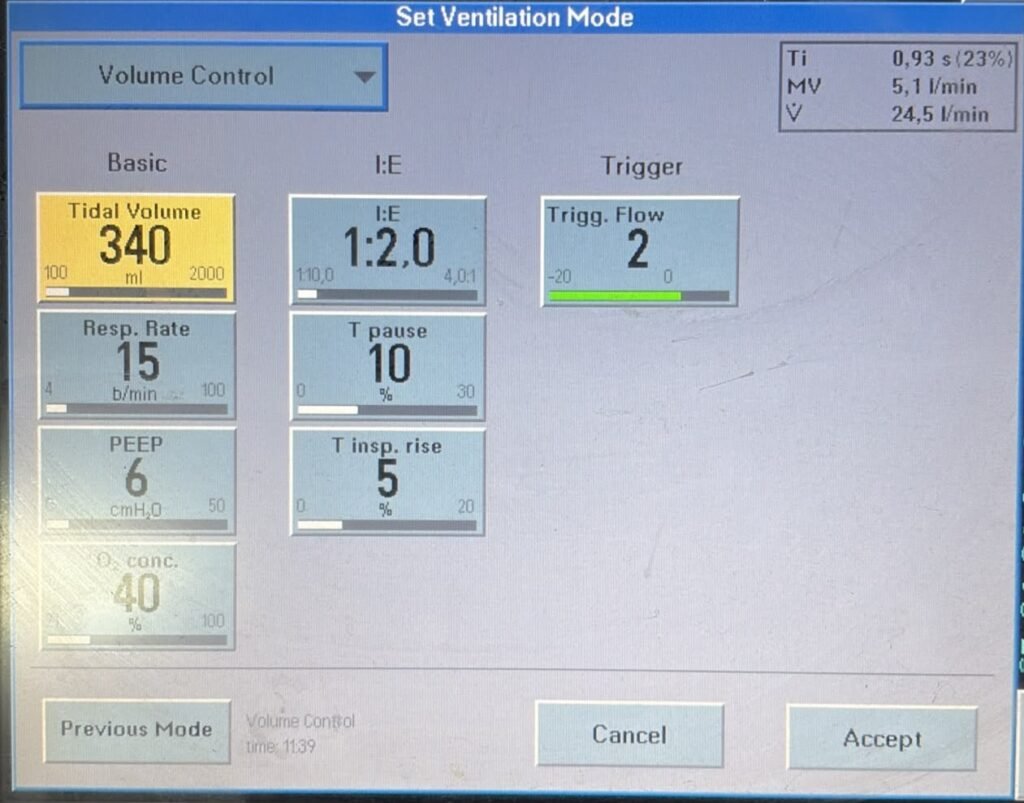
ToggleTrigger
Trigger is the mechanism that initiates a ventilator breath.
In simple words:”What tells the ventilator to start inspiration?”
The trigger may be:Patient generated or Time generated
Types of Trigger
A. Time Trigger
Ventilator starts breath according to set respiratory rate.
Example:RR = 12/min so Breath every: 60/12 = 5 sec
Ventilator triggers breath every 5 sec.
B. Patient Trigger
Patient initiates inspiration.Ventilator detects effort and delivers breath.Two major types:
Flow Trigger vs Pressure Trigger
|
Feature |
Flow Trigger |
Pressure Trigger |
|
Definition |
Ventilator detects a change in inspiratory flow caused by patient’s inspiratory effort. |
Ventilator detects a drop in airway pressure caused by patient’s inspiratory effort. |
|
Mechanism |
Continuous bias flow passes through circuit. Patient effort diverts part of this flow, triggering inspiration. |
Patient must generate negative pressure below the set trigger threshold to initiate inspiration. |
|
Parameter Measured |
Flow (L/min) |
Pressure (cmH₂O) |
|
Typical Setting |
1–3 L/min (most commonly 1–2 L/min) |
−1 to −2 cmH₂O below baseline pressure |
|
Work of Breathing (WOB) |
Lower |
Higher |
|
Effect of Cardiac Oscillations |
Can auto-trigger |
Rarely auto-triggers |
|
Modern ICU Ventilators |
Standard trigger mode |
Less commonly used |
How They Work
Pressure Trigger
- Suppose:PEEP = 5 cmH₂O and Trigger sensitivity = −2 cmH₂O
- Patient must generate:Airway pressure = 3 cmH₂O(5 → 3 cmH₂O)before the ventilator delivers a breath.
- Problem: Patient spends energy creating negative pressure first.
- Patient must overcome:Circuit resistance + Trigger threshold+ Intrinsic PEEP (auto-PEEP) Therefore:Highest inspiratory workload
Flow Trigger
Suppose:Bias flow = 6 L/min and Trigger sensitivity = 2 L/min
Normally:
- Inspiratory limb = 6 L/min
- Expiratory limb = 6 L/min
When patient initiates inspiration:
- Inspiratory limb = 6 L/min
- Expiratory limb = 4 L/min
Difference = 2 L/min —Ventilator immediately triggers a breath. Result: Less effort and faster triggering.
|
Trigger Type |
Very Sensitive |
Normal |
Insensitive |
|
Flow Trigger |
0.5–1 L/min |
1–2 L/min |
>3 L/min |
|
Pressure Trigger |
−0.5 to −1 cmH₂O |
−1 to −2 cmH₂O |
<−3 cmH₂O |
|
Parameter |
Increase Trigger Sensitivity |
Decrease Trigger Sensitivity |
|
Clinical Situation |
Missed triggering (ventilator not detecting patient effort) |
Auto-triggering (ventilator delivers breaths without patient effort) |
|
Flow Trigger |
3 → 2 → 1 L/min |
1 → 2 → 3 L/min |
|
Pressure Trigger |
−3 → −2 → −1 cmH₂O |
−1 → −2 → −3 cmH₂O |
|
Result |
|
|
Rise Time (Tinsp Rise)
- Rise Time (also called Inspiratory Rise Time, Pressure Rise Time, Ramp, Tinsp Rise) is the time required for the ventilator to increase airway pressure from baseline (PEEP) to the target inspiratory pressure during a pressure-targeted breath.
- It determines how fast the ventilator delivers inspiratory flow at the start of inspiration.
Example:
- PEEP = 5 cmH₂O
- Inspiratory Pressure = 20 cmH₂O
Ventilator must increase pressure:
5→20 cmH2 O.If Rise Time = 0.1 sec→ Pressure reaches target in 0.1 sec
- Rise time controls:Inspiratory Flow Delivery
|
Setting Type |
Typical Initial Setting |
Clinical Interpretation |
|
Time-based ventilators |
0.1–0.2 seconds |
Best starting point for most adult ICU patients |
|
Percentage-based ventilators |
5% to 20% of the breath cycle/inspiratory phase |
manufacturer-dependent |
Rise Time vs Inspiratory Time
|
Rise Time |
Inspiratory Time |
|
Time to reach pressure target |
Total inspiration duration |
|
Usually milliseconds |
Usually 0.8–1.2 sec |
|
Initial part of breath |
Entire breath |
Example:Inspiratory time = 1 sec and Rise time = 0.1 sec
0—–0.1————-1 sec
| rise | plateau phase |
Relationship Between Rise Time and Flow
Rise Time ↓—Pressure rises faster—Flow increases—Peak inspiratory flow increases
Why Is Rise Time Important?
Because patients have different inspiratory demands.
Some patients need:High Flow
Examples:
- ARDS
- Metabolic acidosis
- Sepsis
- High respiratory drive
- Exercise breathing pattern
Need:Short Rise Time
Some patients need:Gentle Flow
- Examples:COPD/Asthma/Obstructive disease
- Need:Longer Rise Time
Rise Time Too Slow
- Ventilator provides flow slowly.Patient wants more flow.
- Result:Flow Starvation
- Patient sucks harder.Work of breathing increases.
Tpause
Tpause is the period at the end of inspiration during which inspiratory flow becomes zero while airway pressure is maintained before exhalation begins. Tpause is not mandatory as a routine ventilator setting in all ICU patients.
During Tpause:
- Inspiratory valve closes
- Expiratory valve remains closed
- No gas movement occurs
Therefore: Flow = 0.Since flow is zero: Resistive pressure disappearsand measured airway pressure equals alveolar pressure.This is how ventilators measure:Plateau Pressure (Pplat)
Typical Settings
Usually:0–20% of inspiratory time
or 0.1–0.5 sec.Common ICU setting:0.2–0.3 sec
There are two different concepts that are often confused:
- Inspiratory pause setting (Tpause set on the ventilator) → not routinely required.
- Inspiratory hold maneuver (used to measure plateau pressure) → should be performed periodically in many mechanically ventilated patients, especially ARDS patients.
Historically use To improve oxygenation
Increasing Tpause:Mean Airway Pressure ↑ which may improve:Recruitment and Oxygenation,Especially in:ARDS
So Why don’t we use Tpause routinely?
- Because excessive Tpause can cause:Auto-PEEP
Especially:COPD and Asthma by shortening expiratory time.
- Hemodynamic compromise by Increased intrathoracic pressure can cause:Reduced venous return—Hypotension.
- Increasing Tpause:Inspiratory Time ↑ Thus:Mean Airway Pressure ↑
Higher MAP:
- Improves oxygenation
- Increases recruitment
But excessive MAP:
- Decreases venous return
- Decreases cardiac output
Tpause and I:E Ratio
Example:No Pause
Tinsp = 1 sec and Tex = 2 sec then I:E = 1:2
Add Pause
Tinsp = 1 sec and Tpause = 0.5 sec ,Tex = 2 sec
Effective inspiration:1 + 0.5 = 1.5 sec and I:E becomes:1.5 : 2
or1 : 1.3Thus Tpause lengthens inspiratory phase.
Effects of Increasing Tpause
|
Parameter |
Effect |
|
Plateau pressure |
Easier measurement |
|
Mean airway pressure |
↑ |
|
Oxygenation |
↑ |
|
Recruitment |
↑ |
|
I:E ratio |
Longer inspiration |
|
CO₂ elimination |
Usually unchanged |
|
Cardiac output |
May decrease |
|
Auto-PEEP risk |
May increase if expiration shortened |
End Inspiration (Cycle-Off)
Different ventilator manufacturers label it differently, which is why you may see:
- End Insp = 30%
- Cycle = 30%
- Exp Trigger = 30%
- ETS = 30% (Expiratory Trigger Sensitivity)
- Flow Cycle = 30%
- Termination Criteria = 30%
All of these usually mean the same thing
What does “End Insp = 30%” mean?
During Pressure Support Ventilation (PSV), the ventilator starts inspiration after the trigger.It then delivers inspiratory flow.
As the lungs fill:inspiratory flow is initially high,then gradually decreases.The ventilator must decide:
“When should I stop inspiration and allow expiration?”
This is called cycling.
Example
Suppose peak inspiratory flow is 60 L/min
Flow decreases like this:60–55–50–45–40–35–30–25–20–18–15–10–5
If End Inspiration is 30% that means 30% of 60 = 18 L/min.The ventilator cycles into expiration when inspiratory flow falls to 18 L/min.
Normal values
Most ventilators default to: 25–30% of peak inspiratory flow
Typical range:
|
Setting |
Effect |
|
5–15% |
Long inspiration |
|
20–30% |
Normal/default |
|
40–60% |
Short inspiration |
|
>60% |
Very early cycling |
If End Inspiration is increased
Example 30% → 50% and Peak flow = 60 So 50% = 30 L/min
Ventilator cycles much earlier.
Result
- shorter inspiratory time
- earlier expiration
- smaller tidal volume (if pressure support unchanged)
- useful in COPD to prevent prolonged inspiration and air trapping
I:E Ratio (Inspiratory : Expiratory Ratio)
I:E ratio is the ratio of: Inspiratory Time : Expiratory Time
Example Ti = 1 sec and Te = 2 sec therefore I:E = 1:2
Respiratory Cycle
One complete breath consists of:
- Inspiration (Ti)
- Expiration (Te)
Total Breath Time (TCT)=Total Cycle Time = Ti + Te
Example If one breath lasts 3 seconds
- Inspiration = 1 second
- Expiration = 2 seconds
I:E ratio = 1:2
Normally Expiration is passive. The lungs recoil naturally.
Therefore expiration takes longer than inspiration.
Normal breathing Inspiration ≈33% and Expiration ≈67%
Hence I:E ≈1:2
Factors Affecting I:E Ratio
|
Factor |
How It Affects the I:E Ratio |
|
Respiratory Rate (RR) |
↑ RR → Shortens total respiratory cycle, mainly reducing expiratory time (Te) → Higher I:E ratio(e.g., 1:2 → 1:1.5 or 1:1). ↓ RR → Lengthens Te → Lower I:E ratio (e.g., 1:3–1:4). |
|
Inspiratory Time (Ti) |
↑ Ti → Longer inspiration, shorter expiration → Higher I:E ratio (1:2 → 1:1 or 2:1). ↓ Ti → Shorter inspiration, longer expiration → Lower I:E ratio (1:3–1:4). |
|
Inspiratory Flow Rate (VCV) |
↑ Flow → VT delivered faster → Shorter Ti → Longer Te → Lower I:E ratio (more expiratory time). ↓ Flow → Longer Ti → Shorter Te → Higher I:E ratio. |
|
Tidal Volume (VT) |
At a fixed inspiratory flow, ↑ VT requires more time to deliver → Longer Ti → Higher I:E ratio. ↓ VT → Shorter Ti → Lower I:E ratio. |
|
Inspiratory Pause (Tpause) |
↑ Inspiratory pause prolongs total inspiratory time without changing delivered VT → Shorter Te → Higher I:E ratio. ↓ Tpause → Longer Te → Lower I:E ratio. |
|
Flow Waveform |
Square waveform usually has a shorter Ti for a given peak flow, resulting in more expiratory time (lower I:E). Decelerating flow often prolongs Ti slightly, resulting in higher I:E. |
|
Ventilator Mode |
VCV: I:E depends mainly on flow, VT, and pause. PCV: Ti is directly set by the clinician. PSV: Ti depends on patient effort and cycling criteria. APRV: Uses Thigh and Tlow instead of a conventional I:E ratio. |
|
Patient Inspiratory Demand |
Strong inspiratory effort or delayed cycling may prolong Ti → Higher I:E ratio. Premature cycling shortens Ti → Lower I:E ratio. |
|
Airway Resistance |
Increased resistance (COPD, asthma) requires a longer expiratory time; therefore the I:E ratio is intentionally adjusted to 1:3–1:6 to prevent air trapping. |
|
Lung Compliance |
Decreased compliance (ARDS) often requires a longer inspiratory time to improve alveolar recruitment, resulting in a higher I:E ratio (e.g., 1:1 or inverse ratio ventilation in selected patients). |
|
Auto-PEEP / Dynamic Hyperinflation |
Presence of auto-PEEP necessitates increasing expiratory time (by increasing flow, decreasing RR, or shortening Ti), resulting in a lower I:E ratio. |
|
Inverse Ratio Ventilation (IRV) |
Deliberately prolongs inspiration beyond expiration (e.g., 2:1, 3:1, 4:1) to increase mean airway pressure and improve oxygenation in severe ARDS. |
Bias flow
It is the continuous flow of gas that circulates through the ventilator circuit during expiration, even when the patient is not receiving an inspiratory breath.During expiration, gas continuously flows:Ventilator → Inspiratory limb → Y-piece → Expiratory limb → Ventilator
even though no breath is being delivered.This creates a constant “background flow” called bias flow.Most modern ICU ventilators have a preset bias flow that is automatically managed by the ventilator and is not routinely adjusted by the clinician.
|
Feature |
Bias Flow |
Inspiratory Flow |
|
Present during expiration |
Yes |
No |
|
Used for triggering |
Yes |
No |
|
Typical value |
4–6 L/min |
30–80 L/min |
|
Continuous |
Yes |
No |
|
Delivers tidal volume |
No |
Yes |
VMAX (Peak Inspiratory Flow)
The maximum flow rate (L/min) used by the ventilator to deliver the preset tidal volume during a mandatory VC breath.On the Puritan Bennett™ 980 (PB980), VMAX is the Peak Inspiratory Flow setting (also called maximum inspiratory flow). Think of VMAX as the speed of inspiration.Default adult starting VMAX: 40–60 L/min
On Other Ventilators
|
Ventilator |
Name Used |
|
Puritan Bennett PB980 |
VMAX |
|
Hamilton C6/C3 |
Inspiratory Flow |
|
Dräger Evita |
Flow |
|
Maquet Servo-i/Servo-u |
Inspiratory Flow |
|
Mindray SV series |
Flow |
|
Schiller |
Inspiratory Flow |
Different names, same physiological concept.
Effect of VMAX (Peak Inspiratory Flow)
|
Parameter |
Higher VMAX (Higher Peak Inspiratory Flow) |
Lower VMAX (Lower Peak Inspiratory Flow) |
|
Flow Waveform (Square Flow Pattern) |
Higher rectangular waveform with shorter duration (high flow delivered quickly). |
Lower rectangular waveform with longer duration(same VT delivered more slowly). |
|
Inspiratory Time (TI) |
↓ Shorter TI |
↑ Longer TI |
|
Expiratory Time (TE) |
↑ Longer TE |
↓ Shorter TE |
|
I:E Ratio |
Lower I:E ratio (more time for expiration) |
Higher I:E ratio (more time spent in inspiration) |
|
Peak Inspiratory Pressure (Ppeak) |
↑ Increases due to higher resistive pressure |
↓ Lower because resistive pressure decreases |
|
Plateau Pressure (Pplat) |
Usually unchanged (reflects alveolar pressure, not airway resistance) |
Usually unchanged |
|
Mean Airway Pressure (Pmean) |
↓ Decreases because inspiration is shorter |
↑ Increases because inspiration is prolonged |
|
Airway Resistance Component |
↑ Higher resistive pressure (Ppeak − Pplat increases) |
↓ Lower resistive pressure |
|
Gas Delivery |
Faster gas delivery |
Slower gas delivery |
|
Patient Comfort |
May be uncomfortable if flow exceeds patient demand; can cause coughing or flow overshoot |
May cause air hunger, flow starvation, increased work of breathing, and patient-ventilator dyssynchrony if flow is insufficient |
Clinical Use of VMAX
|
Clinical Situation |
Recommended VMAX |
Rationale |
|
COPD |
70–100 L/min |
Shortens inspiratory time, prolongs expiratory time, reduces air trapping and auto-PEEP |
|
Acute Severe Asthma |
80–120 L/min |
Maximizes expiratory time and minimizes dynamic hyperinflation |
|
ARDS |
40–60 L/min |
Moderate flow minimizes excessive resistive pressure while maintaining lung-protective ventilation |
|
Neurosurgical Patients |
Moderately higher VMAX |
Shorter inspiratory time lowers mean intrathoracic pressure and may improve cerebral venous drainage and venous return |
|
Flow Starvation / Air Hunger |
Increase VMAX until patient demand is met |
Eliminates scooped pressure waveform, improves synchrony and comfort |
Minute Ventilation (VE)
Think of it like this
Imagine filling a bucket with water.
- VMAX (Inspiratory Flow) = How fast the water comes out of the tap
- Units: L/min
- Example: Tap flows at 60 L/min
- Minute Ventilation (VE) = How much water fills the bucket in one minute
- Units: L/min
- Example: Bucket receives 6 L in one minute
The flow rate can be much higher than the total amount delivered per minute, because the ventilator only delivers gas during the inspiratory portion of each breath—not continuously for the entire minute.
This is one of the most common sources of confusion in mechanical ventilation.
|
Feature |
VMAX / Inspiratory Flow |
Minute Ventilation (MV or VE) |
|
Unit |
L/min |
L/min |
|
What it measures |
Rate of gas flow during inspiration |
Total volume of gas delivered in one minute |
|
Represents |
Speed of airflow |
Total ventilation per minute |
|
Depends on |
Inspiratory flow setting |
Tidal volume × Respiratory rate |
|
Formula |
Set by clinician |
VE = VT × RR |
|
Changes Inspiratory Time? |
Yes |
No |
|
Changes Tidal Volume? |
No |
Yes (if VT changes) |
|
Typical Adult Value |
40–60 L/min |
5–8 L/min |