
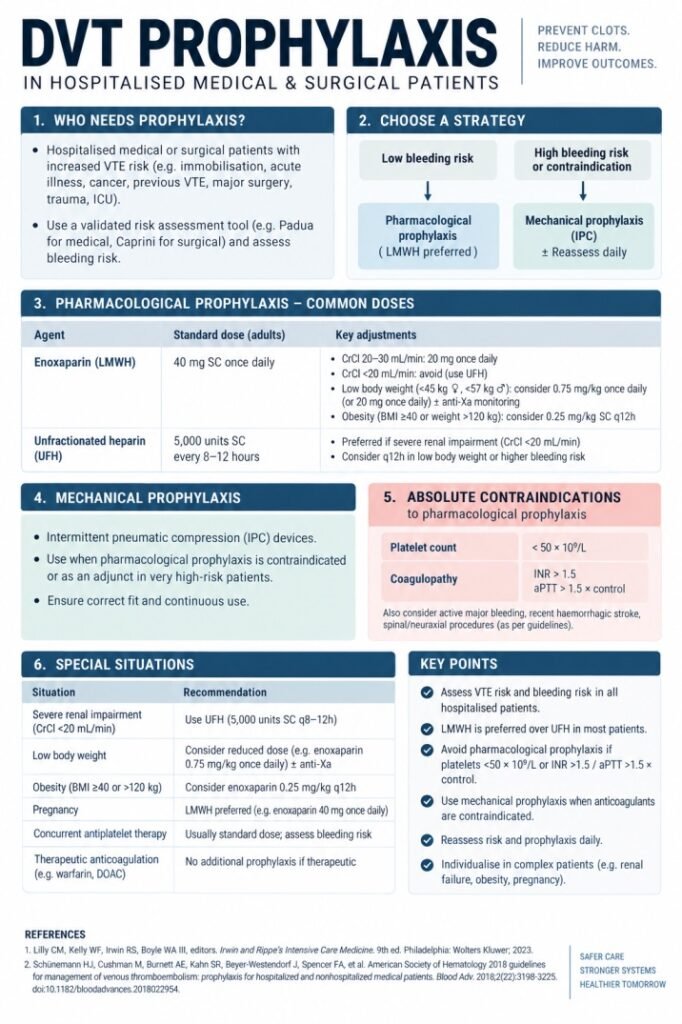
DVT prophylaxis in hospitalized and critically ill patients
Every hospitalized/critically ill patient should undergo a daily assessment of VTE risk AND bleeding risk. If VTE risk is significant and bleeding risk is acceptable → pharmacological prophylaxis, usually LMWH, is preferred. If pharmacological prophylaxis is contraindicated → intermittent pneumatic compression (IPC) should be used.
Table of Contents
ToggleWhy ICU patients are at high risk of DVT
The classical mechanism is Virchow’s triad:
Component | ICU examples |
Venous stasis | Immobility, mechanical ventilation, sedation, paralysis, shock |
Endothelial injury | Central venous catheter, trauma, surgery, inflammation |
Hypercoagulability | Sepsis, cancer, pregnancy, trauma, inflammatory states |
VTE risk versus bleeding risk
- VTE risk HIGH + bleeding risk LOW → pharmacological prophylaxis
- VTE risk HIGH + bleeding risk HIGH → mechanical prophylaxis
- VTE risk LOW + bleeding risk HIGH → often no pharmacological prophylaxis
IMPROVE-BLEED score(including ICU)
Risk factor | Points |
Active gastroduodenal ulcer | 4.5 |
Bleeding in the 3 months before admission | 4 |
Platelet count <50 × 10⁹/L | 4 |
Age ≥85 years | 3.5 |
Hepatic failure (INR >1.5) | 2.5 |
Severe renal failure (GFR <30 mL/min) | 2.5 |
ICU/CCU admission | 2.5 |
Central venous catheter | 2 |
Rheumatic disease | 2 |
Active cancer | 2 |
Male sex | 1 |
Age 40–84 years | 1.5 |
Age <40 years | 0 |
Interpretation
Score | Bleeding risk |
<7 | Lower bleeding risk |
≥7 | High bleeding risk |
Padua Prediction Score
Padua score was developed for acutely ill medical inpatients, not specifically for ICU patients.
Risk factor | Points |
Previous VTE (excluding superficial thrombophlebitis) | 3 |
Known thrombophilia | 3 |
Active cancer | 3 |
Reduced mobility ≥3 days | 3 |
Age ≥70 years | 1 |
Heart and/or respiratory failure | 1 |
Acute myocardial infarction or ischemic stroke | 1 |
Acute infection and/or rheumatologic disorder | 1 |
Obesity (BMI ≥30 kg/m²) | 1 |
Ongoing hormonal treatment | 1 |
Interpretation
Padua score | VTE risk category |
<4 | Low VTE risk |
≥4 | High VTE risk |
For surgical/trauma patients
Score | Population |
Caprini Risk Assessment Model | Surgical patients |
Rogers Score | General/vascular surgical patients |
Trauma Embolic Scoring System (TESS) | Trauma patients |
And don’t mix these with PE/DVT diagnostic scoresThese are not prophylaxis scores:
Score | Purpose |
Wells DVT score | Probability that an existing DVT is present |
Wells PE score | Probability of PE |
Revised Geneva score | Probability of PE |
PERC | Helps exclude PE in selected low-risk patients |
contraindications/cautions include:
- Active bleeding
- platelets <50,000/µL
- significant coagulopathy(INR >1.5,aPTT >1.5× normal)
Other important situations
- Recent major surgery
- Recent neurosurgery
- Acute intracranial hemorrhage
- Unstable intracranial lesion
- Recent invasive procedure
- Severe uncontrolled hypertension in selected high-risk bleeding situations
- High-risk vascular lesion
- Held before Lumbar Puncture
Types of DVT prophylaxis
1. Pharmacological
- LMWH
- UFH
- occasionally fondaparinux in selected patients
2. Mechanical
- Intermittent pneumatic compression (IPC)
- Graduated compression stockings (GCS)
3. Combined
- Pharmacological + mechanical
But combined prophylaxis is not routinely required for every ICU patient. In sepsis and general ICU populations, routine addition of mechanical prophylaxis to pharmacological prophylaxis has not demonstrated sufficient benefit to recommend it universally.
Pharmacological prophylaxis
LMWH
LMWH is generally preferred over UFH when there is no major contraindication.
Advantages
- More predictable pharmacokinetics
- Once-daily administration commonly possible
- Lower HIT risk
- LMWH is more effective and causes less bleeding
Enoxaparin
- CrCl ≥30 mL/min—40 mg SC once daily
- CrCl <30 mL/min—30 mg SC once daily
Low body weight:Female <45 kg,Male <57 kg
→ Standard prophylactic doses may result in increased exposure.
→ Consider bleeding risk carefully.
Enoxaparin 30 mg SC BD For orthopedics Surgical Prophylaxis
Trauma dosing is different
In many trauma protocols:Enoxaparin 40 mg SC BID
is used as an initial standard dose in many adult trauma patients because traditional 30 mg BID may provide inadequate prophylaxis in a substantial proportion of trauma patients.
The Western Trauma Association algorithm describes:
- 40 mg BID for many adults 18–65 years, >50 kg and with CrCl >60 mL/min
- 30 mg BID for older patients, low body weight, or CrCl 30–60 mL/min
with dose adjustment according to patient characteristics and institutional protocols.
- Prophylactic enoxaparin is contraindicated for GFR <20 ml/min.
- Therapeutic enoxaparin is contraindicated for GFR <30 ml/min.
Dalteparin
- DOSE-5000U SC O.D
UFH(unfractionated heparin)
Prophylactic doses:UFH 5,000 units SC every TDS ,Low body weight or age >80 use B.D dosing
Advantages of UFH
- Shorter half-life
- Less renal dependence
- Easier to stop before procedures
- Useful in severe renal dysfunction
- Reversible with protamine
Disadvantages
- More injections
- HIT risk
- Variable pharmacodynamic effect
- Less convenient than LMWH
Fondaparinux
Fondaparinux is a selective factor Xa inhibitor.
Dose-2.5 mg SC once daily( Note-same dose for NSTEMI patients with no plan for cardiac catheterization)
Advantages:
- once daily
- no HIT cross-reactivity in the same way as heparins so use in HIT (heparin-induced thrombocytopenia)
But important limitations:
- GFR <30 ml/min is an absolute contraindication
- It has no reversal.
- very long half-life at 17-21 hours.
- limited ICU-specific evidence
DOACs
- ASH recommends LMWH rather than DOACs for acutely ill hospitalized medical patients. Reasons:altered absorption,renal dysfunction,hepatic dysfunction,drug interactionsprocedures,enteral feeding issues,limited ICU-specific evidence
- Can be used in high risk Patient Who refused LMWH,UFH injections.
Apixaban
Hip/knee replacement prophylaxis
Apixaban 2.5 mg PO BID
Usually started:
- 12–24 hours after surgery, depending on bleeding/hemostasis and the specific procedure.
Typical duration:
- Knee replacement: ~12 days
- Hip replacement: ~35 days
The duration is procedure-specific, not simply “until discharge.”
Rivaroxaban
Hip/knee replacement
Rivaroxaban 10 mg PO once daily
Typical duration:
- Knee replacement → approximately 12 days
- Hip replacement → approximately 35 days
Mechanical prophylaxis
Intermittent pneumatic compression(IPC)
IPC is generally the preferred mechanical method over GCS(Graduated compression stockings)when pharmacological prophylaxis cannot be given.
Mechanism:intermittent limb compression → increased venous flow → reduced venous stasis → potentially increased fibrinolytic activity.
Graduated compression stockings
GCS provide continuous graduated pressure:
highest at ankle → progressively lower proximally
They reduce venous pooling.
Potential problems with GCS:
- improper sizing
- skin injury
- pressure injury
- peripheral arterial disease
- impaired skin integrity
- inability to inspect skin adequately
Contraindications/cautions for mechanical prophylaxis
Be cautious with IPC/GCS in:
- severe peripheral arterial disease
- significant limb ischemia
- severe peripheral neuropathy
- major skin lesions
- burns
- severe edema with compromised skin
- acute limb ischemia
- existing DVT in certain circumstances
- limb trauma or recent vascular surgery
Do not put a compression device over an area where compression could cause injury.
IVC filter
Do NOT use an IVC filter routinely for primary prophylaxis.
An IVC filter does not prevent formation of DVT.
It is intended to prevent embolization to the pulmonary circulation in selected patients.
ASH guidelines recommend against prophylactic IVC filter placement in major surgery.
Typical scenario where an IVC filter might be considered:
Acute proximal DVT/PE + absolute contraindication to anticoagulation
Mobilization
Early mobilization Whenever clinically feasible should be encouraged:
- passive ROM
- active ROM
- sitting
- standing
- ambulation
- physiotherapy
But:Mobilization does not automatically replace pharmacological prophylaxis in a high-risk immobilized ICU patient.
Duration of prophylaxis
The consensus recommends continuing prophylaxis until ICU discharge, although evidence for routine extension beyond hospitalization is limited.
After ICU:Reassess:
- mobility
- ongoing illness
- cancer
- surgery
- previous VTE
- bleeding risk
- discharge destination
Do not automatically continue anticoagulant prophylaxis after discharge in every medical ICU patient.
ASH recommends against routine extended outpatient prophylaxis for most acutely ill medical patients.
Extended prophylaxis
Extended prophylaxis may be considered in selected surgical populations.For example:Major surgery
ASH suggests extended prophylaxis over short-term prophylaxis in selected major surgical patients. Extended prophylaxis was generally defined as beyond approximately 3 weeks, compared with short-term prophylaxis up to about 2 weeks.
This is not the same as routinely extending prophylaxis in every ICU medical patient.
Should every patient undergo screening Doppler?
No.Routine daily/weekly compression ultrasonography screening of asymptomatic ICU patients is not routinely recommended.
European guidance recommends against routine compression-DUS screening of critically ill patients.
Perform diagnostic ultrasound when there is clinical suspicion:
- unilateral swelling
- new asymmetry
- unexplained hypoxemia
- unexplained tachycardia
- unexplained hemodynamic deterioration
- new PE suspicion
Anti-Xa monitoring
Anti-Xa level indicator of heparin efficacy But APTT levels indicator of bleeding risk
Routine anti-Xa monitoring is not required for every patient receiving prophylactic LMWH.
Indication
- GFR 20-30 ml/min.
- Morbid obesity
- very low body weight <45 kg (♀),<57 kg (♂)
- pregnancy
- Draw a peak anti-Xa level ~4 hours after the 3rd dose
- BID enoxaparin prophylaxis Peak anti-Xa = 0.2–0.4 IU/mL
Peak anti-Xa | Adjustment |
<0.20 IU/mL | Increase enoxaparin by 10 mg/dose |
0.20–0.40 IU/mL | Continue current dose |
0.41–0.50 IU/mL | Decrease by 10 mg/dose |
>0.50 IU/mL | More substantial dose reduction; reassess bleeding/renal function |
Neurosurgical patients
Intracranial hemorrhage Initially: Mechanical prophylaxis
But Once:
- hematoma is stable
- repeat imaging demonstrates stability
- neurosurgical team agrees
- bleeding risk is acceptable
→ pharmacological prophylaxis can be initiated.
The consensus suggests considering chemical prophylaxis after approximately 24–48 h in hemorrhagic stroke/neurosurgical patients following clinical, radiological and neurosurgical assessment. The exact timing must be individualized.
Ischemic stroke
Immobility after ischemic stroke produces significant VTE risk.
In patients with low bleeding risk, pharmacological prophylaxis can be initiated relatively early.
The consensus suggests chemical prophylaxis within approximately 24 hours in ischemic stroke when bleeding risk is low.
But remember:
Acute stroke thrombolysis/EVT patients
Timing must account for:
- thrombolytic therapy
- infarct size
- hemorrhagic transformation
- post-procedure imaging
- intracranial bleeding risk
Major trauma
Trauma is a special population because:
VTE risk ↑↑ but bleeding risk ↑↑
Initially, if active bleeding/high bleeding risk:
IPC/mechanical prophylaxis
Once:
- hemorrhage is controlled
- hemodynamics are stable
- intracranial lesion is stable where applicable
- no urgent operation is anticipated
→ start pharmacological prophylaxis.
The ISCCM consensus suggests considering chemical prophylaxis approximately 24–48 hours after severe trauma once bleeding/hematoma expansion risk is judged acceptable.
Cancer patients
Cancer increases:VTE risk,recurrence risk
but also potentially:
- thrombocytopenia
- bleeding
- invasive procedures
Hospitalized patients with active cancer and acute medical illness generally receive pharmacological prophylaxis when bleeding risk is acceptable.
Pregnancy
Pregnancy is a hypercoagulable state.
Low bleeding risk→ LMWH or UFH
High bleeding risk→ mechanical prophylaxis
Liver disease
Elevated INR does NOT automatically mean “auto-anticoagulated.”
Patients with cirrhosis can develop:DVT,PE,portal vein thrombosisdespite prolonged INR.
Therefore:
Do not withhold VTE prophylaxis solely because the INR is elevated in cirrhosis.
In ACLF, SCCM guidance suggests LMWH over pneumatic compression stockings for VTE prophylaxis in hospitalized patients, although evidence quality is low.
Obesity
- >100 kg and/or BMI >30
Obesity creates two problems:
- Increased VTE risk
- Potential underdosing with fixed prophylactic doses
Therefore, in severe obesity:
- standard fixed-dose prophylaxis may be inadequate
- some centers use higher doses
- weight-based regimens may be considered
- anti-Xa monitoring may be considered in selected patients
BMI ≥40 kg/m² or marked obesity: consider increased prophylactic dosing (commonly enoxaparin 40 mg SC q12h) according to institutional protocol; anti-Xa monitoring may be considered in extreme obesity.
Thrombocytopenia
Platelet count | General approach |
<50k | Usually avoid pharmacological prophylaxis if bleeding risk is significant; use IPC |
Very low/active bleeding | Mechanical/no pharmacological prophylaxis |
The 50,000/µL threshold is a commonly used practical ICU cutoff, not an absolute universal biological threshold.The overall clinical context matters.
if patient is on Concurrent antiplatelet agents?
Do not routinely reduce prophylactic LMWH or UFH solely because the patient is taking aspirin or another antiplatelet drug.
Assess VTE risk + bleeding risk + indication for antiplatelet therapy.
Situation | Approach |
Aspirin alone + high VTE risk + low bleeding risk | Standard prophylactic LMWH/UFH dose |
Clopidogrel alone + high VTE risk + low bleeding risk | Usually standard prophylactic dose, with increased bleeding vigilance |
Aspirin + clopidogrel (DAPT) | Higher bleeding risk → reassess need for pharmacological prophylaxis carefully |
DAPT + active bleeding/high bleeding risk | Mechanical prophylaxis (IPC) rather than anticoagulant prophylaxis |
if patient is on Concurrent Warfarin?
Warfarin itself is already providing systemic anticoagulation. Adding prophylactic-dose heparin creates additional bleeding risk without a routine prophylactic benefit.
Epidural/spinal catheter
- This requires strict adherence to regional-anesthesia anticoagulation timing recommendations By ASRA
- The combination of:neuraxial catheter + anticoagulation can produce catastrophic spinal/epidural hematoma.
- Therefore, prophylactic LMWH/UFH timing must be coordinated with:insertion,removal,restart of neuraxial catheters.
Patient is on CRRT?
CRRT creates a particularly complex situation.
Do not automatically assume that anticoagulation used to keep the CRRT circuit patent provides adequate systemic VTE prophylaxis.
For example:
- regional citrate anticoagulation → primarily circuit anticoagulation
- systemic heparin → may provide systemic anticoagulant effect
HIT(heparin-induced thrombocytopenia)
- If the patient develops suspected heparin-induced thrombocytopenia:Stop ALL heparin
- HIT is a prothrombotic condition.
- Use a suitable non-heparin anticoagulant ,Bivalirudin and argatroban are direct thrombin inhibitors (DTIs) that can be used here
References
- Lilly CM, Kelly WF, Irwin RS, Boyle WA III, editors. Irwin and Rippe’s Intensive Care Medicine. 9th ed. Philadelphia: Wolters Kluwer; 2023.
- Schünemann HJ, Cushman M, Burnett AE, Kahn SR, Beyer-Westendorf J, Spencer FA, et al. American Society of Hematology 2018 guidelines for management of venous thromboembolism: prophylaxis for hospitalized and nonhospitalized medical patients. Blood Adv. 2018;2(22):3198-3225. doi:10.1182/bloodadvances.2018022954.