If Internal Medicine Is Foreplay, Then Critical Care Is the Climax
Part 1—Which Books Should You Read?
The answer depends on what stage of training you are in.
1. Irwin & Rippe’s Intensive Care Medicine — The Bible
Because it doesn’t merely tell you what to do—it explains why.
The strength of Irwin lies in its detailed discussion of physiology, pathophysiology, and clinical reasoning. It builds concepts rather than providing isolated facts.
If I had to recommend only one comprehensive textbook to a trainee intensivist, this would be it.
2. Textbook of Critical Care by Vincent — An Excellent Alternative
However, compared with Irwin & Rippe, many chapters are more concise and less explanatory. It often tells you the destination but spends less time describing the journey.
3. Oh’s Intensive Care Manual — The Entrance Exam Champion
The Oh’s Intensive Care Manual occupies a special place in critical care training.
If your goal is:
- IDCCM preparation
- Entrance examinations
- One-year fellowship programs
- Rapid revision during residency
then Oh’s Manual is incredibly valuable.
4. Washington Manual of Critical Care — The Resident’s Companion
The Washington Manual of Critical Care is perhaps one of the most practical bedside books available.
It is particularly useful for:
- Junior residents
- Postgraduate students
- Night duties
- Quick ICU decision-making
Part 2—The Reality Check
- Most trainees believe that if they finish Irwin, they will “know Critical Care.”They won’t.
- They then think that perhaps reading Irwin, Vincent, Oh’s Manual, and Washington Manual together will solve the problem.It won’t.
- In fact, even after reading all of them, you may not have covered even 80% of what you will encounter in your ICU career.Why?
- Because Critical Care is not a superspecialty in the traditional sense.It is an amalgamation of multiple superspecialties.
An intensivist manages:
- Cardiology problems/Pulmonology problems
- Nephrology problems/Gastroenterology problems
- Neurology problems/Endocrinology problems
- Infectious disease problems/Hematology problems
- Surgical problems/Trauma problems
all in the same shift.
- The level of knowledge expected from an intensivist often extends far beyond what traditional critical care textbooks can provide.
- When dealing with cardiogenic shock, you may need concepts from Braunwald’s Heart Disease.
- When managing thyroid storm or refractory hypoglycemia, you may need insights from Williams Textbook of Endocrinology.
- When discussing severe glomerulonephritis, advanced pulmonary hypertension, or acute liver failure, you may find yourself diving into nephrology, pulmonology, or hepatology texts.
- The ICU simply adds its own layer of complexity
Part 3—The Solution: A Better Way to Learn Critical Care
The mistake many trainees make is believing there is a finish line.There isn’t.
- Critical Care is a lifelong learning process.
- Your goal during residency is not to master every disease.
- Your goal is to build a strong foundation for that Start with a major textbook.(Personally, I prefer Irwin & Rippe.)
Once the foundation is strong, let your patients become your teachers.
- A patient with pulmonary hypertension should push you toward advanced cardiopulmonary physiology.
- A patient with fulminant liver failure should force you to learn hepatology.
- A patient with refractory vasoplegia should make you revisit cardiovascular physiology.
The Final Lesson
- During residency, many of us begin with the belief that medicine is finite.
- One day we will read enough, know enough, and finally feel comfortable.
- Reality teaches us otherwise.The deeper you go, the more you realize how much remains unexplored.
- As training progresses, you start learning more and more about fewer and fewer things.
Eventually, you become highly knowledgeable about a narrow area.
And then comes the final realization:
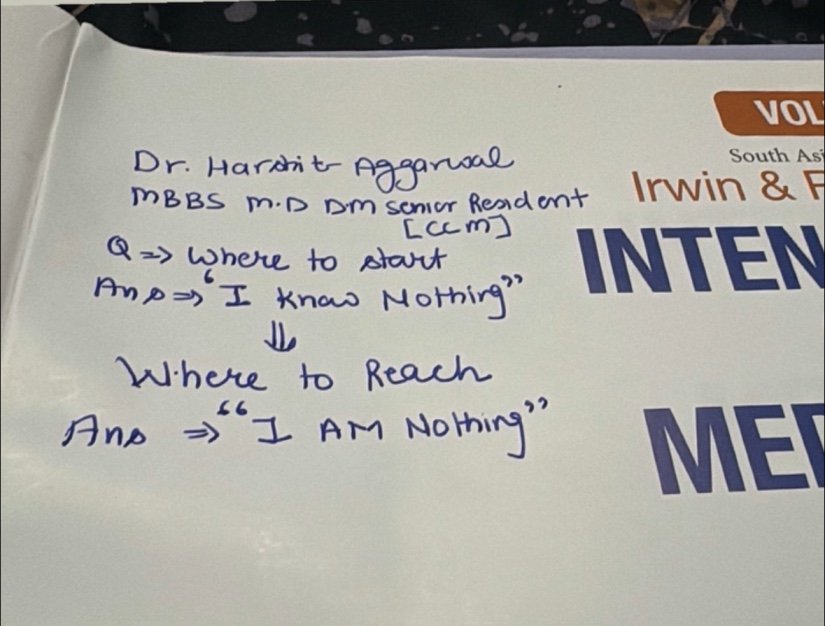
“The goal of residency is not to know everything.
The goal is to learn how to keep learning.
And perhaps that is the beauty of this specialty.
You never truly finish learning it.”